Fictional demonstration · synthetic operational data
AI Document Operations
A working fictional review surface for turning documents into structured, validated, human-approved operational records.
Select a document, compare evidence with output, edit a field, resolve a system mismatch, choose a route, approve or reject, and inspect the updated audit trail. Concept demonstration built by Pixelity using fictional data.
AI Document Operations fictional demonstration ready.
AI Document Operations
Concept demonstration built by Pixelity using fictional dataInbox
11 sample documentsINV-2025-004867.pdf
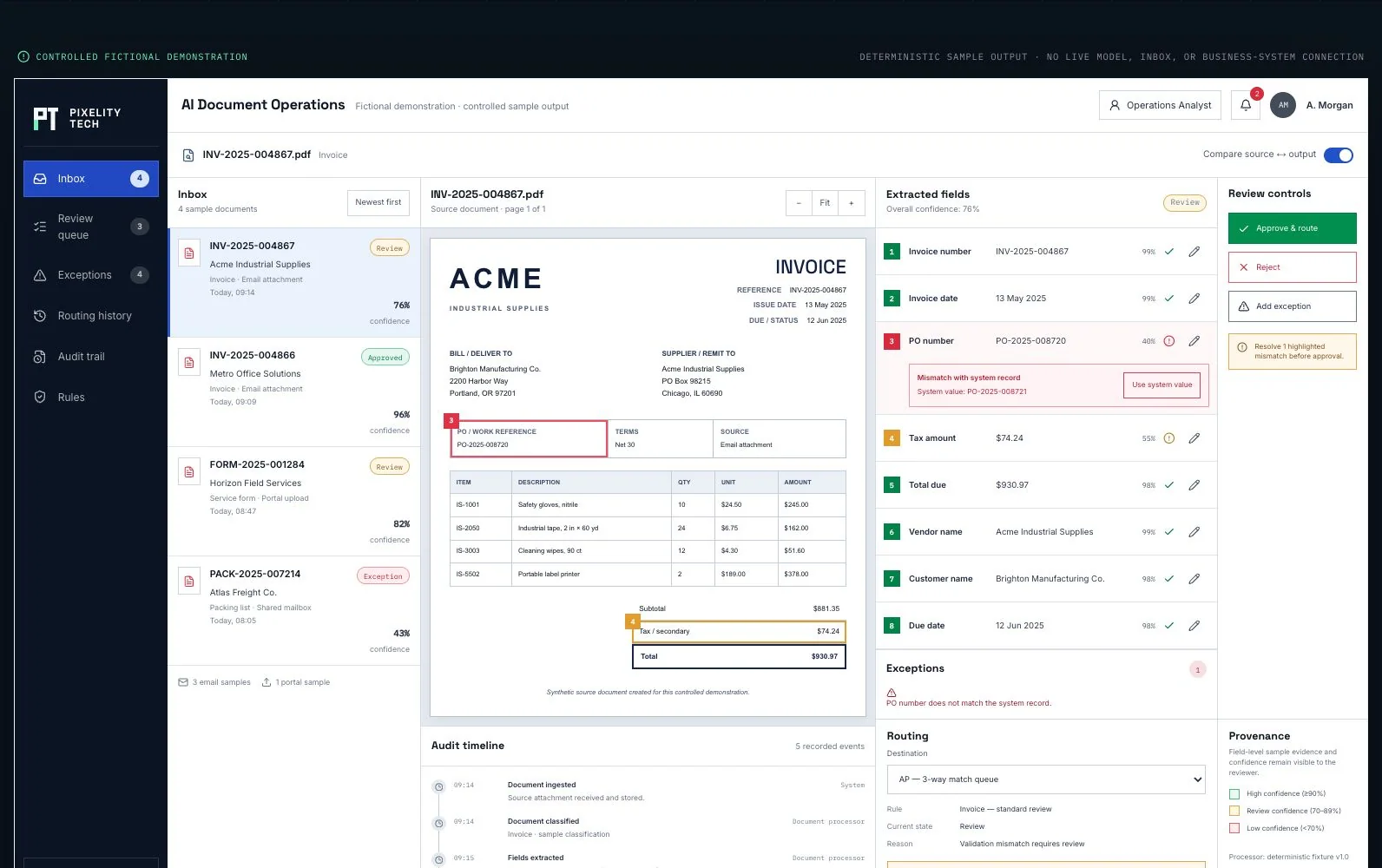
Source document · page 1 of 1 · scanned at 300 DPITax Invoice
Industrial supplies · VAT registered- Reference
- INV-2025-004867
- Issue date
- 13 May 2025
- Due date
- 12 Jun 2025
- PO / work reference
- PO-2025-008720
- Terms
- Net 30 · USD
- Intake channel
- Email attachment
| Item | Description | Qty | Unit | Amount |
|---|---|---|---|---|
| IS-1001 | Safety gloves, nitrile (L) | 10 | $24.50 | $245.00 |
| IS-2050 | Industrial tape, 2 in × 60 yd | 24 | $6.75 | $162.00 |
| IS-3003 | Cleaning wipes, 90 ct | 12 | $4.30 | $51.60 |
| IS-5502 | Portable label printer | 2 | $189.00 | $378.00 |
- Subtotal
- $881.35
- Tax
- $74.24
- Total
- $930.97
Extracted fields
Overall confidence: 76%Exceptions
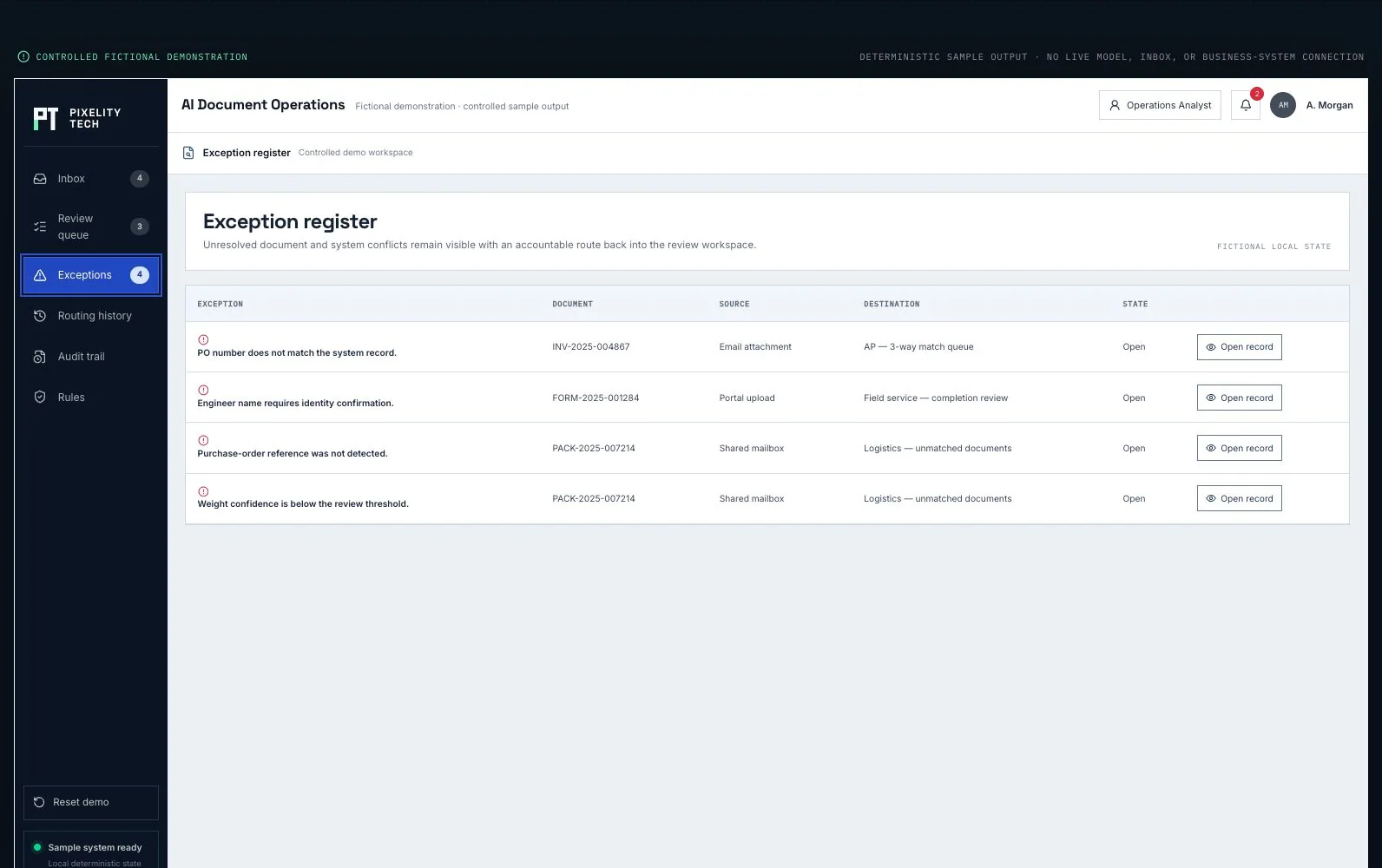
1- PO number does not match the system record.Open
Review controls
Resolve 1 highlighted mismatch before approval.
Routing
- Rule
- Invoice — standard review
- Current state
- Review
- Reason
- Validation mismatch requires review
Provenance
Field-level sample evidence and confidence remain visible to the reviewer.
- High confidence (≥90%)
- Review confidence (70–89%)
- Low confidence (<70%)
No live model call is made.
Audit timeline
5 recorded events- Document ingestedSource attachment received and stored.System
- Document classifiedInvoice · classification completeDocument processor
- Fields extractedExtraction complete · 76% overall confidenceDocument processor
- Validation completedField and system-match rules evaluated.Validation rules
- Queued for human reviewAssigned to A. Morgan.Workflow
Product views
Screens from the working demonstration
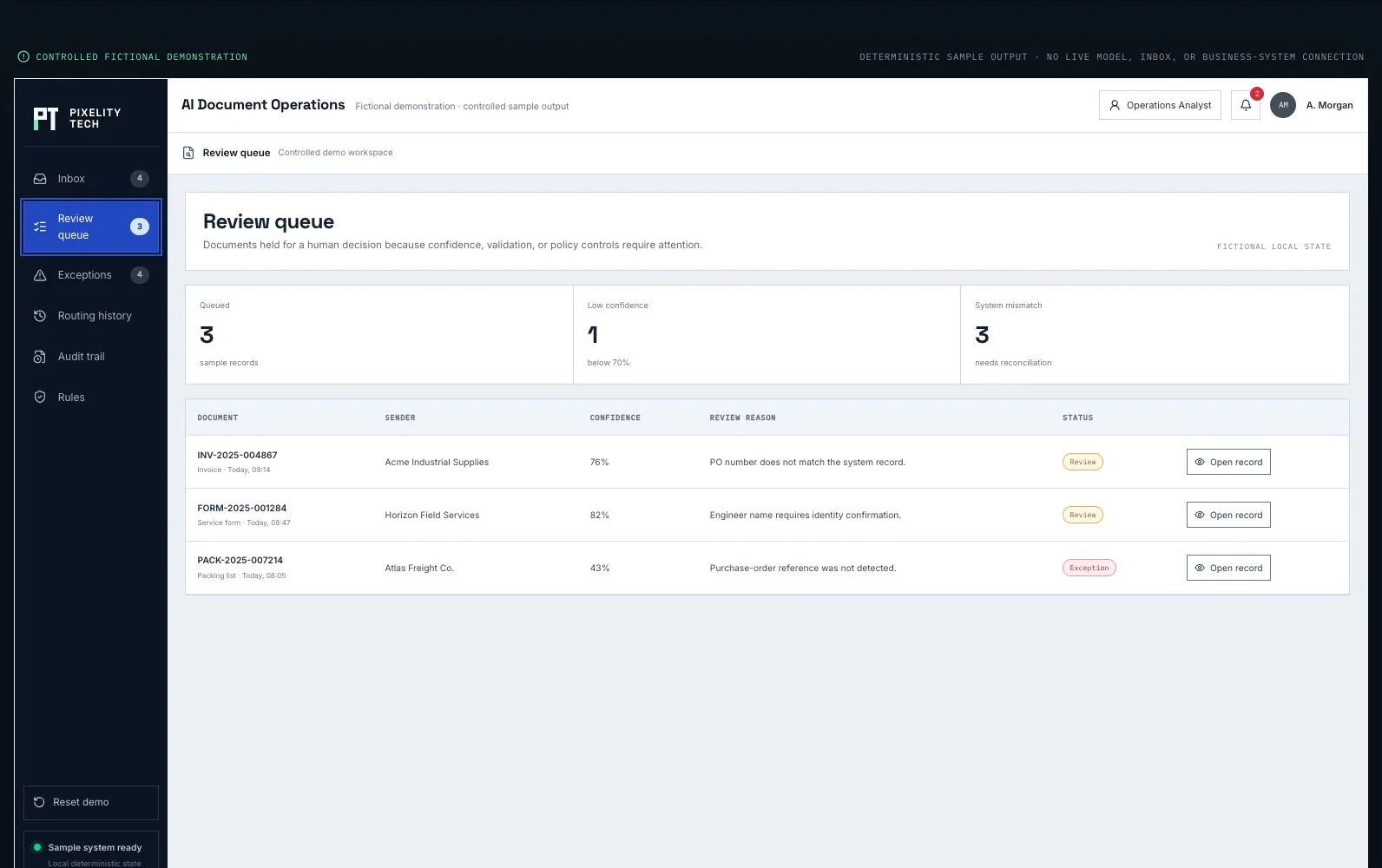
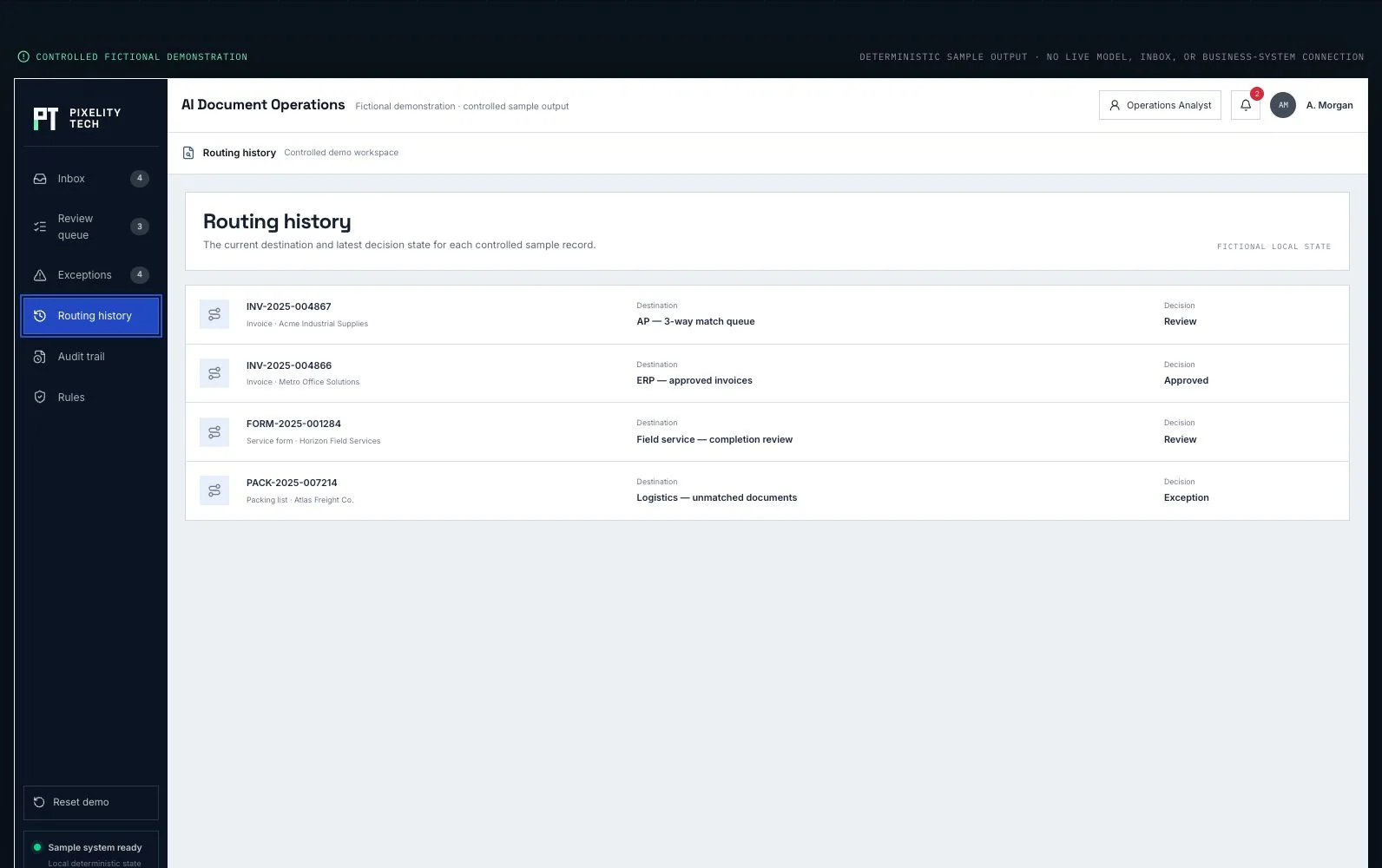
Captured from the interactive application above. Every organization, person, value, and record shown is fictional.
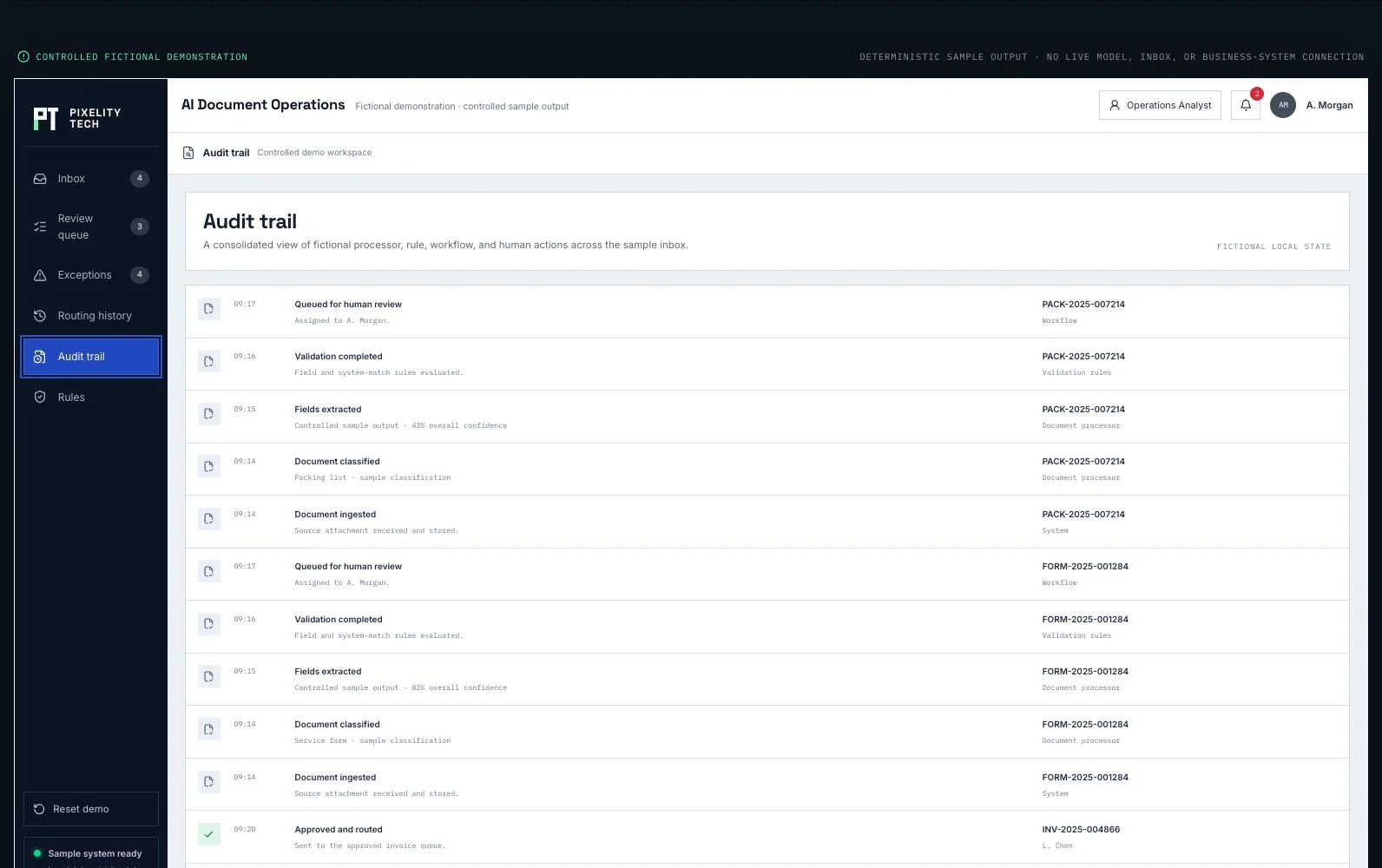
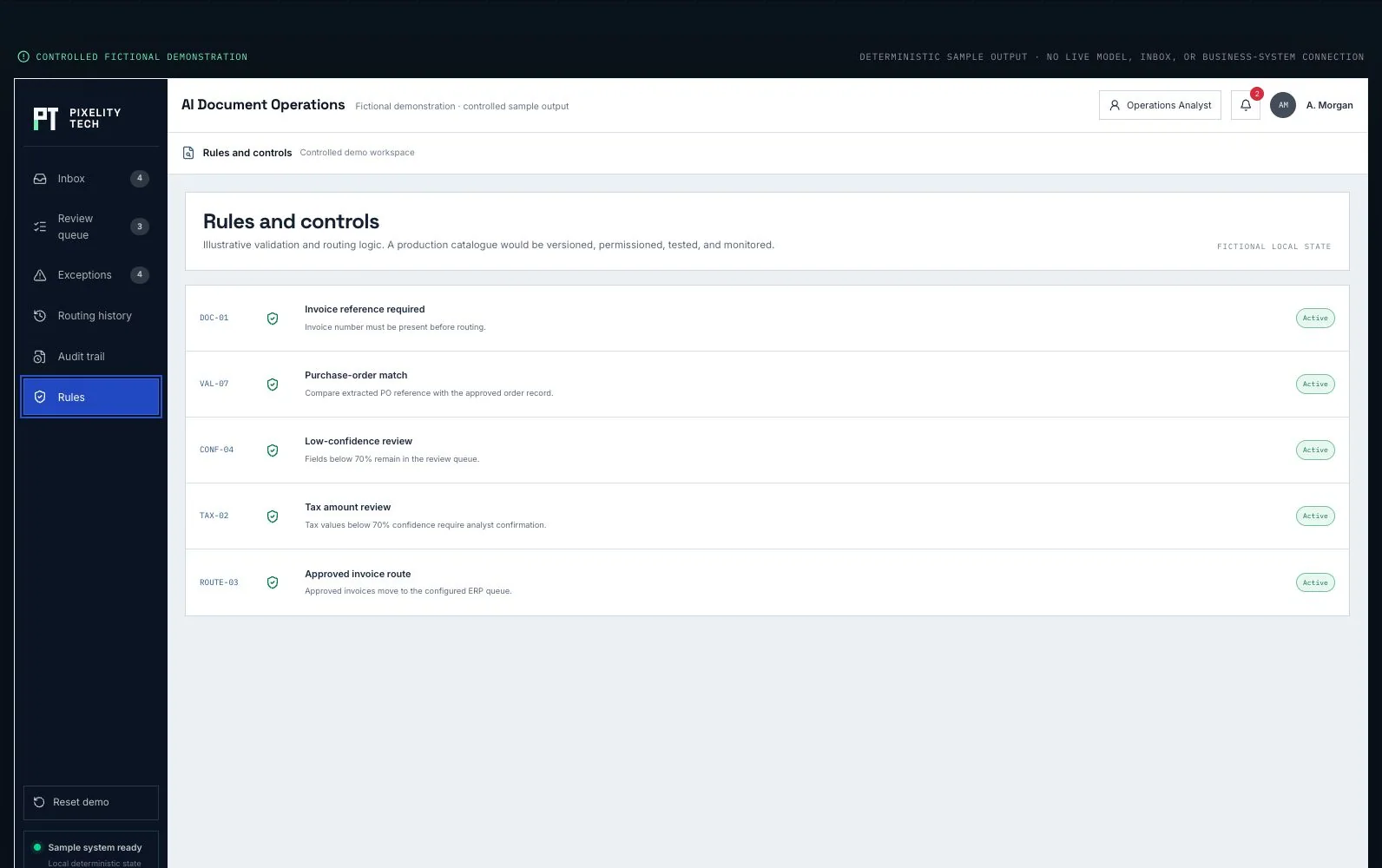
01
The problem is not document reading. It is controlled action.
Attachments arrive through several channels, values are retyped into business systems, and ambiguous records are reconciled in private messages. The risk sits in the hand-off between evidence and action.
02
Walk the record from intake to route.
The demonstration is deliberately deterministic. It shows the application and control design around document processing without pretending to call a live AI service.
- 01Select a document
Choose any synthetic record in the inbox and review its source, state, and confidence.
- 02Compare evidence
Keep source and structured output visible together, or focus the review panel with the comparison control.
- 03Inspect validation
Confidence, system matches, and exceptions remain field-level signals rather than a single opaque score.
- 04Correct a field
Edit an extracted value and save it. The review action is appended to that document’s audit timeline.
- 05Resolve the mismatch
Use the supplied system value for the highlighted reference and confirm that the control state changes.
- 06Choose a route
Select a fictional downstream destination based on document type and review outcome.
- 07Approve or reject
Complete the human decision. Status, route, exception state, and the audit trail update together.
03
Roles, rules, and exceptions remain explicit.
Automation can accelerate the routine path while the application preserves accountable human authority for uncertain or consequential records.
Roles
- Operations analyst
- Reviews evidence, corrects fields, resolves mismatches, and chooses the route.
- Process owner
- Defines document schemas, confidence thresholds, validation rules, and exception ownership.
- System administrator
- Controls role access, downstream connections, retention, monitoring, and recovery.
Rules and exceptions
- Field confidence
- Low-confidence values enter human review; the threshold can vary by field and document type.
- System reconciliation
- References can be checked against an ERP, CRM, work-order system, or approved master data.
- Exception routing
- Missing, contradictory, or policy-sensitive values are held in an accountable queue.
- Human authority
- A model suggestion never becomes an approved business record without the configured control path.
04
A workflow layer between documents and business systems.
The production architecture would be selected around document volume, data sensitivity, latency, model choice, downstream APIs, and the consequence of a wrong write.
Microsoft 365 or Gmail intake, object storage, OCR or document-model providers, ERP and finance systems, CRM, workflow queues, identity, observability, and audit storage. None are connected in this demonstration.
05
The application is shaped around the control model.
A real implementation would not reuse these sample documents or rules. It would encode the document evidence, authority, and routing logic your operation requires.
- 01Document types, layouts, languages, and extraction schemas
- 02Per-field confidence and validation thresholds
- 03Review roles, permission boundaries, and approval limits
- 04Exception queues, owners, response windows, and escalation
- 05Routing destinations and downstream write-back behavior
- 06Evidence retention, audit events, and operational reporting
Design the controlled path