Pixelity Tech / Field note
How Much Custom Business Software Should Cost
What a credible custom-software budget includes, which variables move it, and how to compare estimates without rewarding false precision.
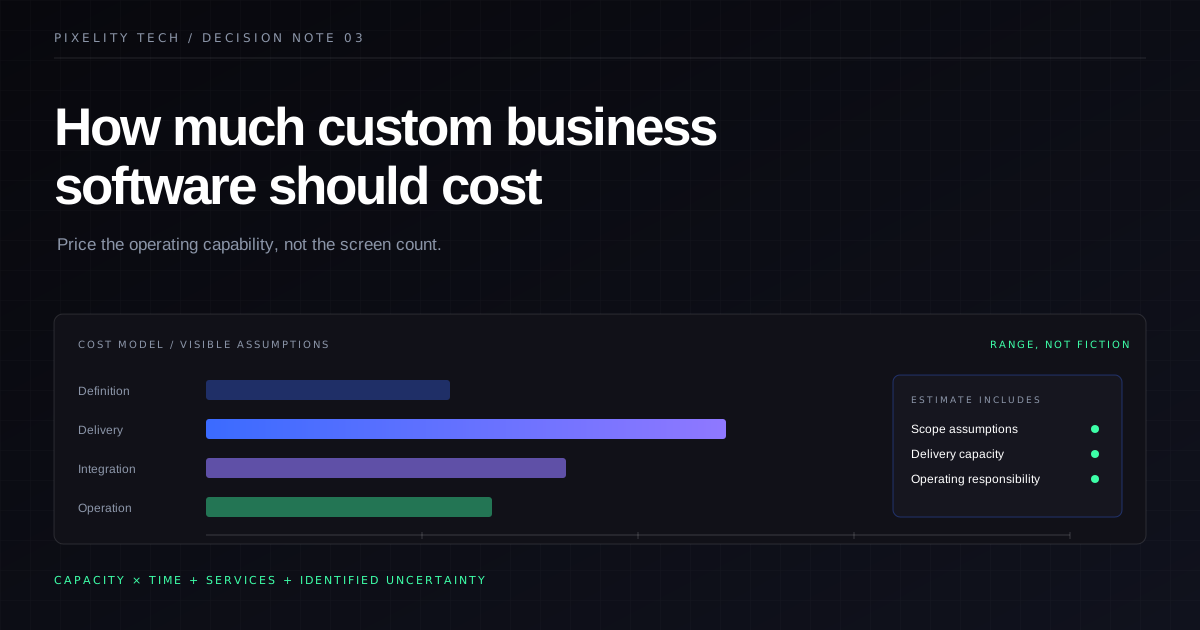
There is no responsible universal price for custom business software. An approval tool for one team, an operational platform across several companies, and a regulated customer portal are all “custom software,” but they do not share a meaningful price tag.
That does not mean the cost is unknowable. It means the estimate must be tied to a defined operational outcome, a delivery approach, and explicit assumptions.
The most useful early answer is a range with reasons: what the range includes, what could move it, and what the first investment will prove. A precise quote produced before those facts are known is not certainty. It is uncertainty hidden inside a number.
Price the operating change, not the screen count
Screens are visible, so they are easy to count. They are also a poor proxy for effort.
A plain interface may sit on top of difficult work: permissions across business units, reconciliation between systems, audit history, complex pricing, document extraction, offline behavior, or migration from inconsistent records. A visually rich dashboard can be straightforward if its data is already clean and accessible.
Start by defining what must change in the operation:
- Who will use the system, and for which decisions?
- What event starts the workflow?
- Which information must be available at each step?
- What rules determine the next action?
- Which exceptions need human judgment?
- What existing systems remain authoritative?
- What evidence or audit trail must be retained?
- What outcome will show that the release is useful?
Those answers reveal the real unit of scope: a working operational capability.
The main variables that move cost
Workflow complexity
A linear workflow with one user role is different from a process with conditional paths, delegation, escalations, reversals, and cross-company approvals. Each rule must be understood, represented, tested, and supported.
Complexity is often hiding in phrases such as “it should work the same as today” or “except for special clients.” List those exceptions before estimating.
Data quality and migration
Moving clean, consistent records from one documented database is predictable. Combining years of spreadsheets, duplicated contacts, free-text fields, attachments, and conflicting identifiers is not.
Migration work includes profiling the source, defining the target, cleaning and reconciling records, rehearsing the move, validating the result, and deciding what remains archived. It is part of the product, not an administrative task after development.
Integrations
An integration with a stable, documented API is easier to plan than one involving file drops, desktop software, undocumented fields, or a vendor-controlled implementation partner.
The estimate must also cover failure behavior. What happens when the other system is slow, unavailable, or returns unexpected data? Who can retry or reconcile the transaction? A connector that only works on the happy path is not complete.
Permissions, security, and assurance
The difference between “signed-in users can view records” and a multi-tenant permission model is substantial. So is the difference between ordinary business data and information that requires stricter retention, audit, hosting, or review practices.
Security should not appear as an optional line at the end of a proposal. Authentication, authorization, auditability, dependency management, deployment controls, backup, and recovery are architectural work.
Experience breadth
One desktop workflow for trained internal users is narrower than a system supporting customers, suppliers, field staff, administrators, mobile devices, accessibility needs, localization, and intermittent connectivity.
Responsive design does not automatically create a good mobile field workflow. If the context differs, the product design and testing need to reflect it.
Operational readiness
Deployment is not the end of the cost. A usable production release needs environments, monitoring, logs, backups, support ownership, documentation, onboarding, and a way to release changes safely.
If an estimate includes feature development but excludes how the software will be operated, compare it carefully with one that includes production readiness.
A cost model you can inspect
A transparent estimate can be expressed as:
Delivery capacity over time + infrastructure and third-party services + contingency for identified uncertainty
Delivery capacity includes the mix of product, design, engineering, and quality work required during each stage. The mix should change as the project moves from discovery to implementation and rollout; not every discipline needs the same allocation every week.
Infrastructure and third-party services include hosting, email or messaging, observability, file storage, identity, maps, AI models, and any vendor licenses the system consumes.
Contingency should correspond to known uncertainty, not be a concealed margin. A legacy integration with incomplete documentation deserves more uncertainty allowance than a standard managed service. The estimate should say so.
This model lets you challenge assumptions. If one proposal is materially lower, ask which capacity, operational responsibility, or risk it excludes.
Budget by decision stage
Do not force the entire programme into one irreversible commitment. Structure investment so each stage produces evidence for the next.
1. Definition
Map the workflow, inspect systems and data, identify users and constraints, define the initial capability, and document the largest risks. The output should make the build more estimable, not simply produce a longer requirements document.
2. Proof
Test the most uncertain technical or operational assumption. This may be an integration, a migration sample, a rules engine, or a realistic interactive prototype. A proof should answer a named question.
3. First production release
Deliver one complete workflow to real users with the security, data, monitoring, and support it needs. Narrow does not mean disposable. It means fewer capabilities brought to a production standard.
4. Expansion
Add roles, workflows, automation, reporting, and integrations based on observed use. At this point, estimates can draw on the actual architecture and delivery rate rather than speculation.
Pixelity’s custom software service uses definition and proof stages to reduce expensive uncertainty before a larger build begins.
What a credible estimate should contain
Ask for more than a total. A useful estimate should show:
- the capability and user journey being delivered;
- the assumptions about users, data, integrations, and environments;
- what is included in design, engineering, testing, and rollout;
- client responsibilities and required decision-makers;
- third-party and ongoing operating costs;
- explicit exclusions;
- important risks and how they will be tested;
- a change process when assumptions prove wrong;
- the ownership and handover model;
- the evidence used to approve each stage.
It should also distinguish a fixed scope from an estimate. Fixed-price work can be appropriate when the problem and acceptance conditions are stable. When discovery is still happening, apparent price certainty often transfers risk into exclusions, change requests, or reduced quality.
Compare proposals on the same basis
Normalize every proposal into a shared view. Does it include migration? Real integrations or only placeholders? Production environments? Accessibility? Security review? Monitoring? Training? Warranty or support? Source-code and infrastructure ownership?
Then compare the proposed team and method. Who is responsible for product decisions? How will working software be reviewed? How often will risks be demonstrated? What will exist if the engagement stops after the first stage?
A more expensive proposal may include work another has deferred. A lower proposal may be genuinely more efficient. The only way to tell is to examine scope, assumptions, and operating responsibility rather than the total alone.
Control cost by controlling uncertainty
Cost overruns usually start before development. The team commits to an undefined workflow, discovers problematic data late, treats integrations as simple, or allows every stakeholder requirement into the first release.
You can reduce that risk by:
- appointing one accountable product owner;
- putting realistic data into the process early;
- testing the hardest integration before building around it;
- defining the smallest complete operational slice;
- reviewing working software frequently;
- keeping a visible list of assumptions and decisions;
- treating new scope as a trade-off, not a free addition.
The goal is not the smallest initial quote. It is the lowest credible cost of reaching and sustaining the business outcome.
If you need to understand the likely shape of a system before seeking estimates, explore the operations command center demo, then map the first complete workflow that the budget must cover.
Custom Software Versus Off-the-Shelf Software
A practical way to decide whether your business should adapt to an existing product or invest in software designed around its operation.
Read field note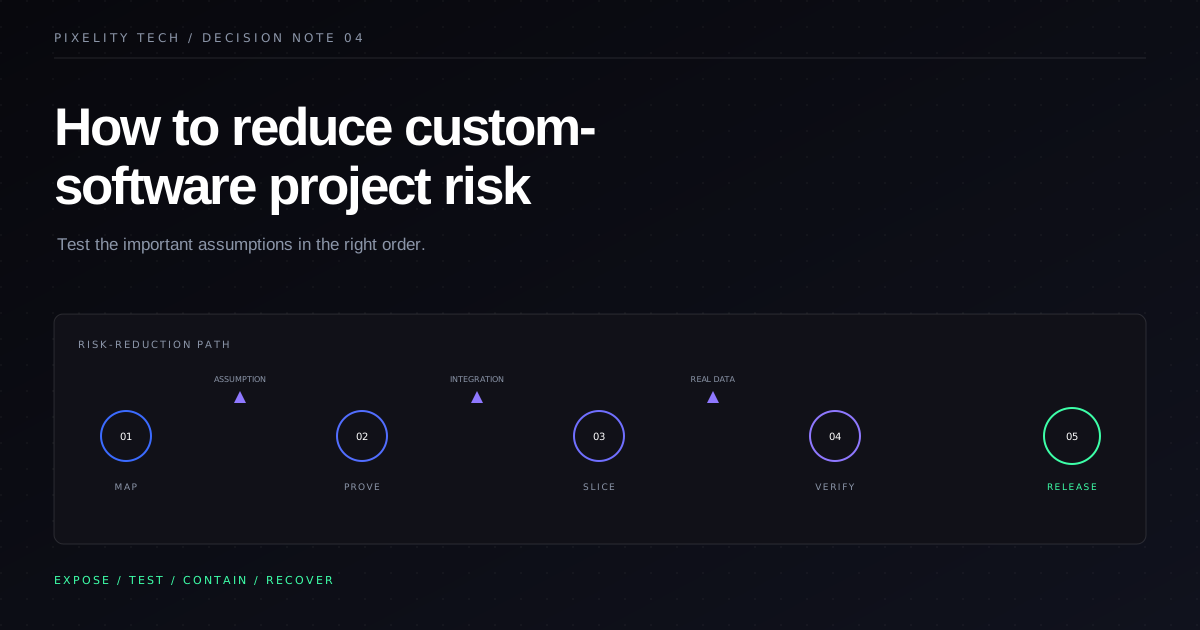
How to Reduce Custom-Software Project Risk
A practical risk-control model for custom software, from workflow definition and technical proofs to rollout, ownership, and recovery.
Read field note