Pixelity Tech / Field note
How to Reduce Custom-Software Project Risk
A practical risk-control model for custom software, from workflow definition and technical proofs to rollout, ownership, and recovery.
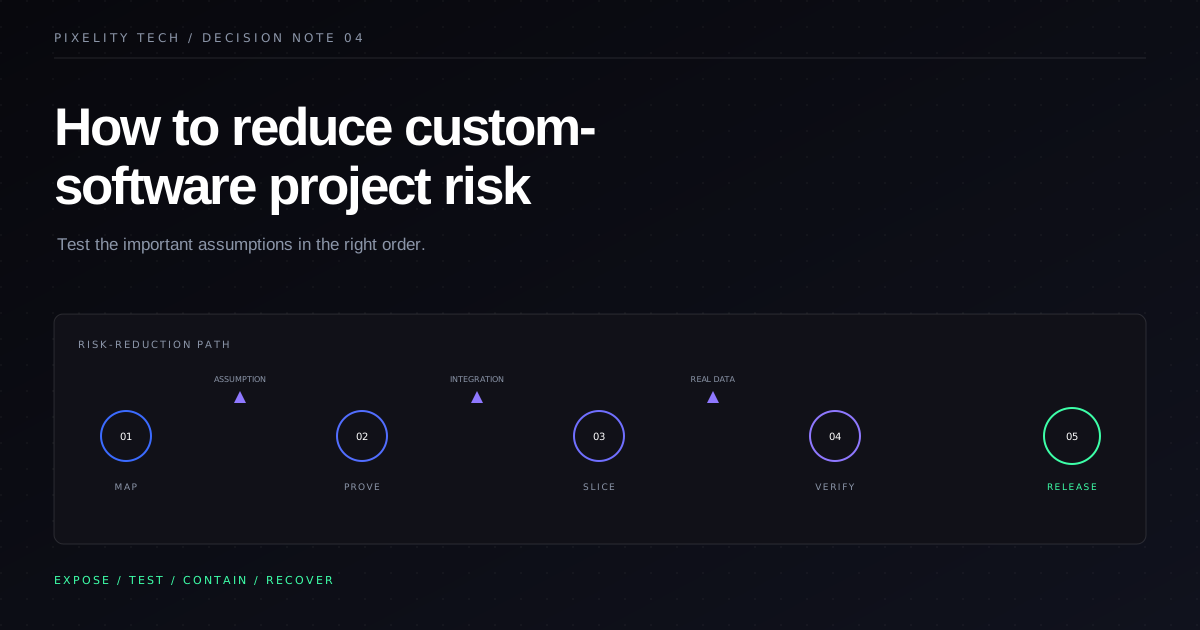
Custom-software projects are not risky simply because code is being written. They become risky when important assumptions remain invisible until the system is expensive to change.
The workflow may be less consistent than leaders believe. Source data may not support the required decisions. An integration may behave differently in production. Users may reject a technically correct process. The client and delivery team may assume different ownership after launch.
Risk management is the work of identifying those assumptions, testing them in the right order, and limiting the consequence when one proves wrong.
Keep a risk register that changes the plan
A risk register is useful only when it affects delivery. Start with a small set of concrete risks and record:
- what might be untrue or fail;
- the consequence if it does;
- the evidence currently available;
- the next action that will reduce uncertainty;
- the owner;
- the date by which the action must happen.
“Integration risk: medium” is not actionable. “The finance system may not expose invoice-line status through its API; test the endpoint with a production-like account before designing reconciliation” is.
Review the list during planning and demonstrations. If the highest-risk item is unchanged for several reviews, the project is probably working around uncertainty rather than reducing it.
Validate the workflow before encoding it
Do not automate a process simply because it exists. Observe how work actually moves, including informal hand-offs and exceptions. Compare that with the documented process and decide which behavior belongs in the future system.
For each step, establish:
- the trigger;
- the accountable role;
- the required information;
- the decision or action;
- the possible next states;
- the exceptions;
- the evidence that must be retained.
Remove steps that exist only to compensate for disconnected tools. Resolve unclear ownership. Standardize harmless variation. Keep meaningful judgment visible rather than burying it inside an automatic rule.
Our workflow automation service treats process design as part of delivery because automating ambiguity only makes it move faster.
Build the riskiest slice first
Teams naturally start with familiar work: authentication, navigation, and simple record screens. That creates visible progress while leaving the difficult questions untouched.
Identify the assumption most capable of invalidating the solution. It may be:
- access to data in a legacy platform;
- the accuracy of document extraction;
- a complex permission boundary;
- performance over a large operational dataset;
- offline synchronization for field teams;
- a migration rule for inconsistent records;
- whether users can make the required decision from the proposed interface.
Build the smallest proof that can answer that question. Use realistic samples and failure cases. If the proof fails, change direction while the system is still inexpensive to change.
Deliver vertical slices, not disconnected layers
A vertical slice takes one useful workflow from interface to data, integration, permissions, monitoring, and support behavior. It is narrower than the final product but complete enough to evaluate honestly.
Layer-based delivery can hide risk. A team may report that the database, API, and interface are each mostly complete even though no real user can finish a task. Integration and usability problems then converge near the end.
Frequent vertical slices create shared evidence. Stakeholders can see whether the software reflects the operation, engineers can test production-like behavior, and the team can make scope decisions using a working system.
The operations command center demo shows how a slice can connect status, ownership, exceptions, and action rather than presenting isolated dashboard components.
Put representative data in early
Placeholder data conceals structural problems. Realistic data reveals long names, missing fields, duplicates, contradictory statuses, unusual relationships, and volumes that change interface and performance decisions.
Create a safe representative dataset early. Remove or transform sensitive information when necessary, but preserve the important shape and edge cases. Use it in prototypes, migration rehearsals, testing, and demonstrations.
Define who decides how conflicting records are resolved. Engineering can implement reconciliation rules, but it should not invent business meaning for ambiguous data.
Treat integrations as products with failure states
An integration is not complete when one successful request returns expected data. It needs an owner and a lifecycle.
For each integration, define:
- the authoritative system for each field;
- how identity and permissions are mapped;
- expected frequency and latency;
- duplicate and ordering behavior;
- retry and idempotency rules;
- reconciliation after partial failure;
- monitoring and alerting;
- what users see when the dependency is unavailable;
- how changes in the external API are handled.
Test degraded behavior deliberately. If the accounting system is unavailable, can operations continue safely? If a webhook arrives twice, does the workflow create duplicate work? If a record cannot be matched, where does it go for review?
These are product decisions, not just technical details.
Make quality visible in acceptance criteria
“The feature works” is incomplete. Acceptance criteria should include the qualities that make the system safe to operate.
Depending on the capability, that may include:
- authorization rules for each role;
- validation and useful error recovery;
- accessibility for the intended users;
- audit events for important actions;
- performance under representative load;
- monitoring and diagnostic information;
- backup and restore behavior;
- browser, device, or connectivity conditions;
- a rollback or feature-control mechanism.
Automated tests should protect important rules and contracts. Manual checks should examine end-to-end behavior, usability, and conditions that are difficult to automate. Neither is meaningful without representative scenarios.
Control scope through outcomes and trade-offs
Risk increases when every reasonable idea is treated as a launch requirement. Define the first release around an operational outcome: one team can complete one valuable workflow with clear ownership and dependable data.
When new scope appears, make the trade-off explicit. Add it and move another item, extend time or capacity, or defer it. Do not quietly compress design, testing, security, or rollout work to preserve every feature and the original date.
Keep deferred items visible with the reason and condition for reconsidering them. This distinguishes deliberate staging from forgotten promises.
Plan adoption and transition as product work
A sound system can still fail if rollout is treated as an announcement.
Identify who will change behavior, what existing work must continue during transition, and how records will be reconciled. Train people on the workflow and decisions, not only the interface. Give users a clear support route. Prepare operational owners to diagnose and escalate problems.
For important processes, consider a controlled rollout by team, location, or workflow. Define the condition for expanding and the condition for pausing. Keep a documented recovery path if the release must be rolled back.
Protect ownership after launch
Before delivery ends, establish:
- ownership of source code, cloud accounts, domains, and data;
- access for the people responsible for operation;
- architecture and decision documentation;
- deployment and recovery instructions;
- dependency and security-update ownership;
- monitoring and support responsibilities;
- how future changes will be prioritized and released.
Custom software reduces vendor dependency only if the organization can understand and operate what it owns. A handover should be tested: another competent person should be able to deploy, diagnose, and recover the system using the provided access and documentation.
Use governance proportionate to consequence
Not every internal tool needs the controls of a critical operational platform. Apply rigor according to the consequence of failure, the sensitivity of data, the number of users, and the difficulty of recovery.
The principle is consistent even when the controls differ: expose assumptions early, make quality part of the work, and preserve the ability to recover.
If your project is still a broad feature list, begin with the custom software service and identify the one vertical slice that would reduce the most uncertainty before a larger commitment.
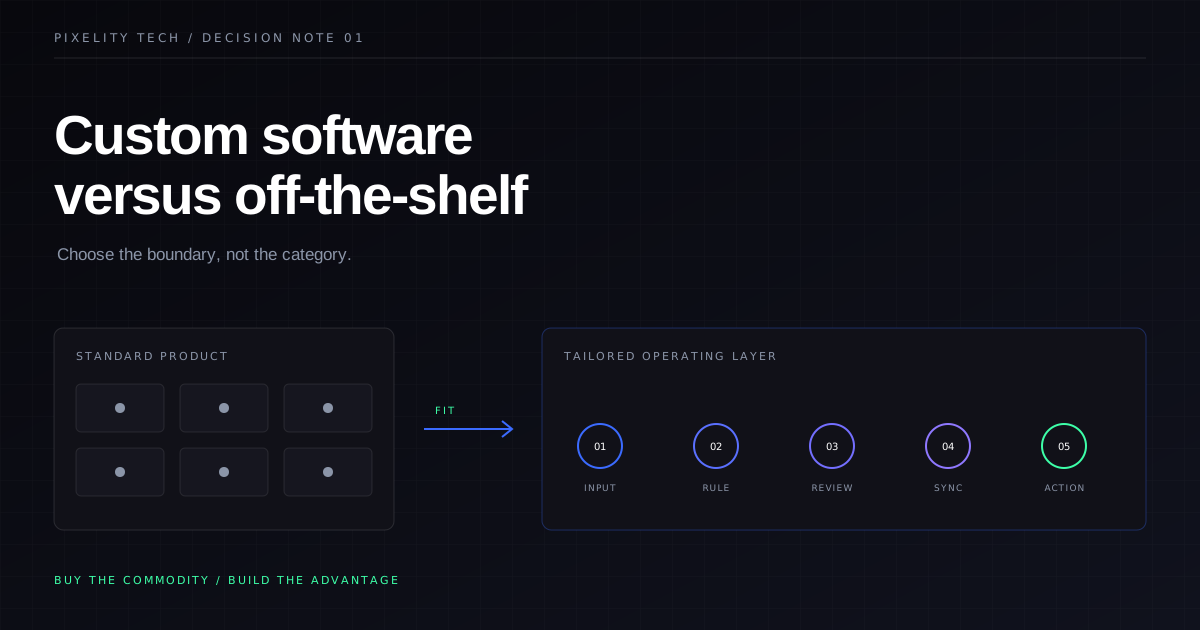
Custom Software Versus Off-the-Shelf Software
A practical way to decide whether your business should adapt to an existing product or invest in software designed around its operation.
Read field note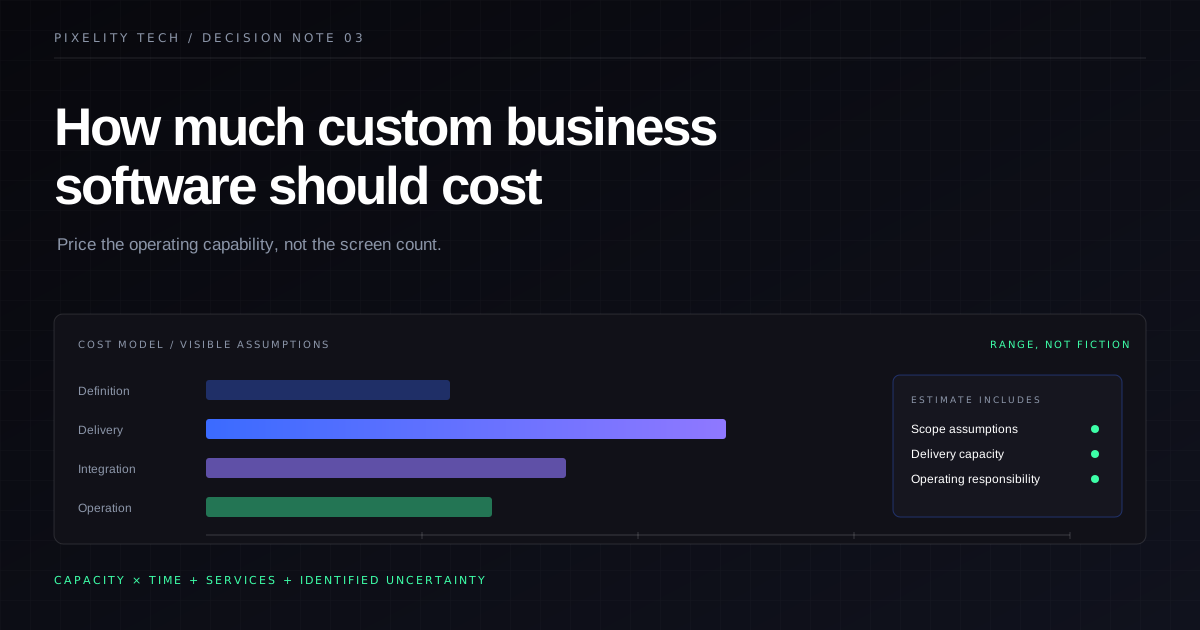
How Much Custom Business Software Should Cost
What a credible custom-software budget includes, which variables move it, and how to compare estimates without rewarding false precision.
Read field note