One picture of the operation, not one screen for everyone.
Centralizing is not marching every team onto one dashboard. A scheduler and a controller need different screens. What has to be shared is underneath: one record per real thing, and states that mean the same everywhere.
- 01Capture
- 02Assign
- 03Control
- 04Exception
- 05Insight
Start where two teams already argue about the same job. Each of them keeps their own screen.
Every function holds a partial copy of the same job
Sales, operations, finance, and service each run the tool that suits them, and each holds part of the record for the same customer and the same job. Nothing links the four, and no status word means quite the same thing in all of them. So when leadership asks where something stands, the answer has to be assembled by people, which is why it arrives late and rarely twice the same way.
How the problem shows up day to day.
- 01
Status meetings are data-gathering exercises
The first half of the meeting establishes what actually happened, because nobody could read it off a record beforehand.
- 02
Exceptions hide in individual inboxes
Blocked work stays with whoever found it, and becomes visible when a date is missed or a customer calls rather than when it became blocked.
- 03
The same word means two things
A job marked complete in operations is not yet complete in finance, so two departments report two different numbers and both are correct.
How work moves today.
- 01
Work starts inside one function
Each team creates the record in its own tool under its own reference, so the same job exists three times and matches nowhere.
- 02
Coordination happens in meetings
Alignment between teams depends on a recurring call and a status slide someone rebuilt by hand that morning.
- 03
Problems travel by escalation
A blocker moves because someone raises it personally, not because it appeared in a queue the moment it occurred.
- 04
Leadership reads last month
The pack is compiled from exports and reconciled between departments, and it describes a position the operation has already left.
How the same work moves once the system holds it.
- 01
One record per real thing
A customer, a job, an order exists once and is referenced by every function, so four teams annotate the same object instead of maintaining four copies of it.
- 02
States defined once
The states a job can hold, and who may move it between them, are agreed across teams and enforced by the system rather than by convention.
- 03
A view per role, not a screen for all
The scheduler, the approver, and the controller each get the view their work needs. What they see differs; the records and states underneath do not.
- 04
Reporting reads the live record
Backlog, capacity, exceptions, and trends come from the records teams operate daily, so leadership and the floor are looking at the same thing at the same moment.
What has to be built for that to hold.
- 01
Core entity model
Customers, work, resources, and the financial links between them, with relationships and ownership defined once for every function that touches them.
- 02
Shared states and exception register
One vocabulary of states, and one register where blocked, overdue, and out-of-policy work is visible to whoever can clear it. Pixelity built Wazzan Holding an operations platform on this shape: four roles, one schedule that respects conflicts, travel, and leave, and completion evidenced by photo before invoicing follows.
- 03
Role-based views and reporting
Queues and dashboards per role, drawn on shared definitions with the underlying records one step away. We have built internal and group-level business systems for AMKM Investments.
Screens from a related demonstration.
Captured from Pixelity's fictional product demonstrations. Organizations, people, and records shown are synthetic.
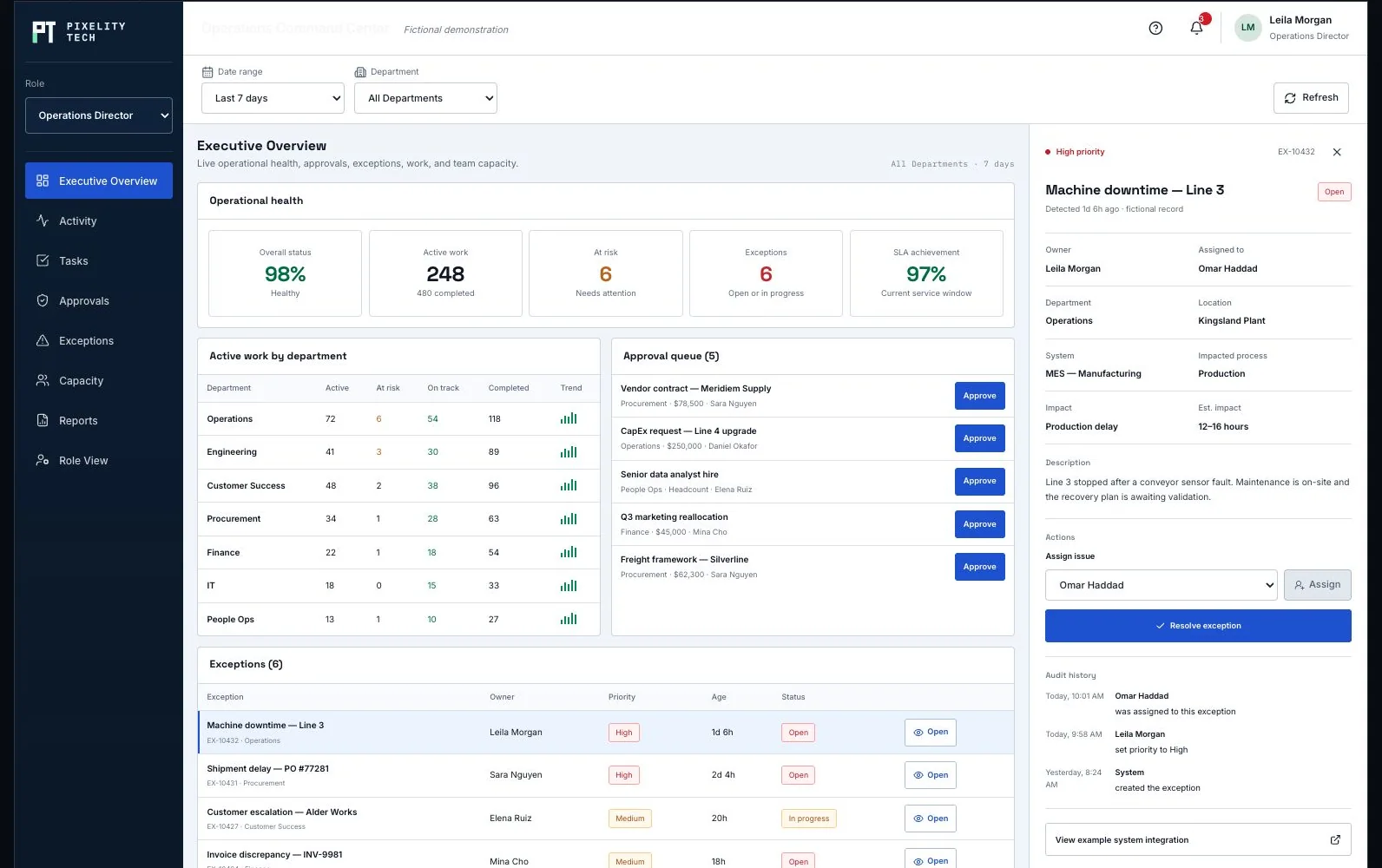
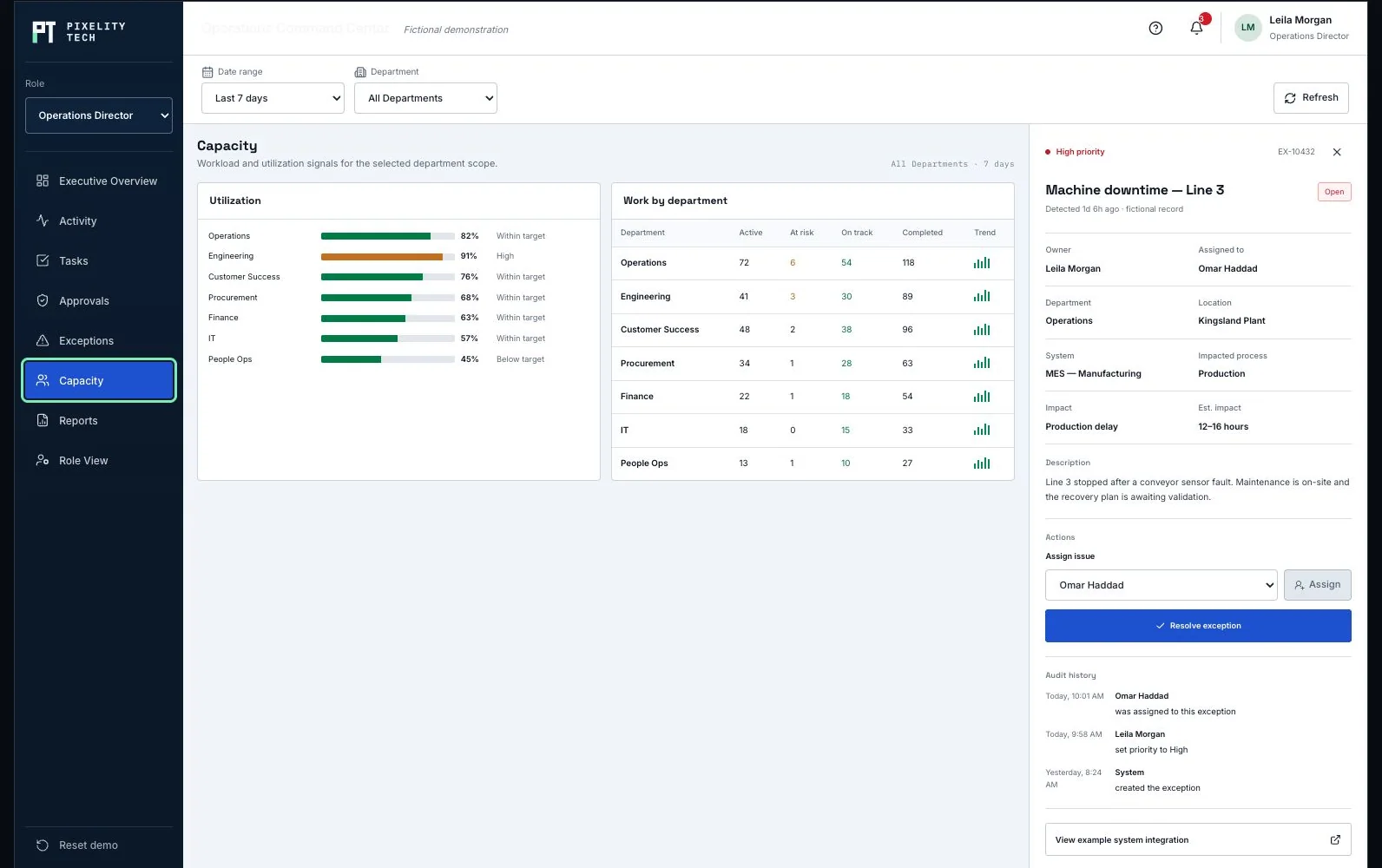
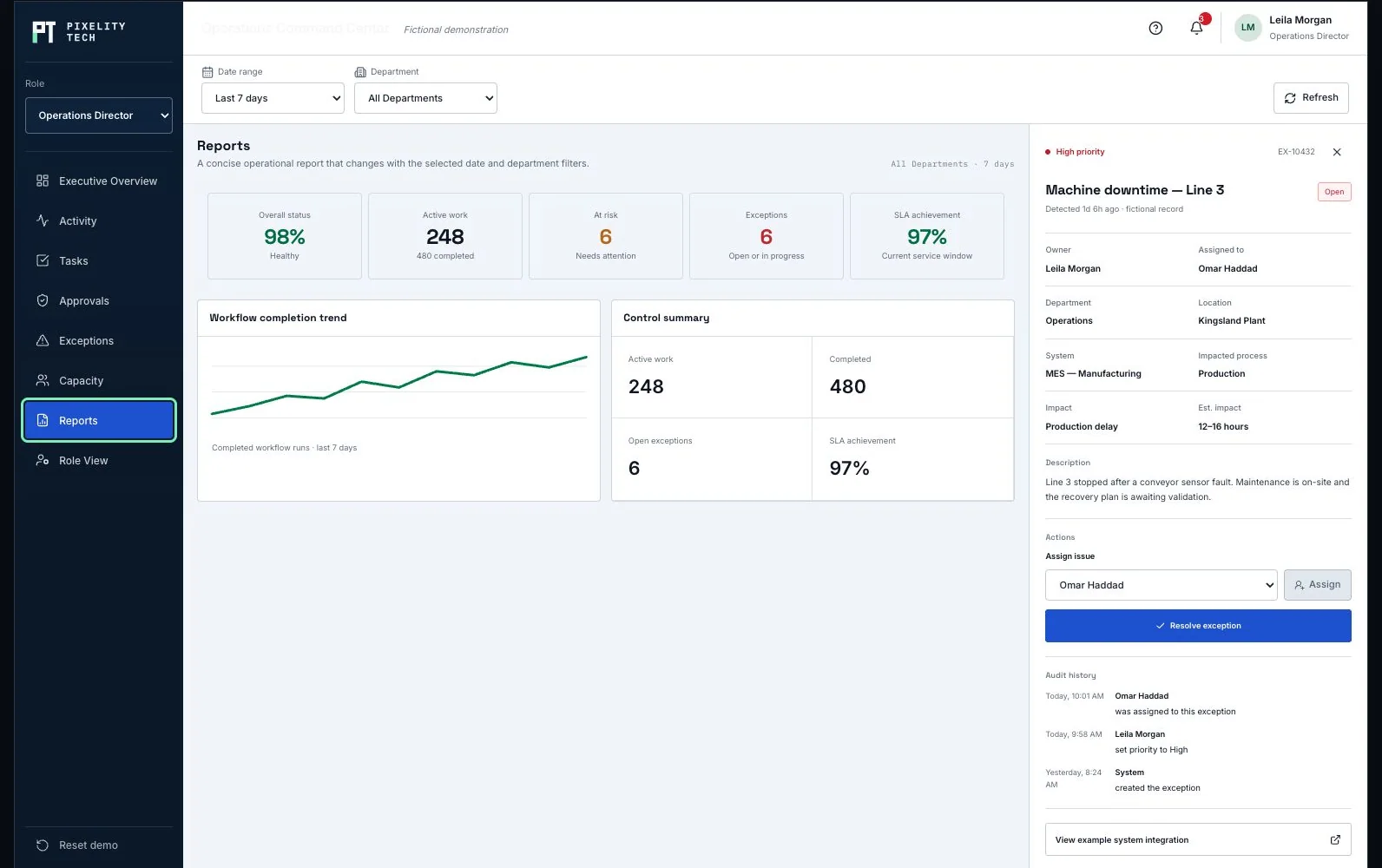
Operations Command Center
A fictional operation where activity, responsibilities, approvals, exceptions, capacity, and reporting all read from one set of records.
Open the demonstration- 01Activity
- 02Ownership
- 03Approval
- 04Exception
- 05Reporting
The kinds of system this usually becomes.
Adjacent problems that often appear together.
Articles that help frame the decision.
Tell us the process everyone works around.
Describe it in a sentence or two. We will come back with what we would build first, what it would take, and whether you actually need us for it.