Pixelity Tech / Field note
How to Design an Operational Source of Truth
A source of truth is an ownership model, not a dashboard. Learn how to define authoritative data, workflow state, provenance, and reconciliation across business systems.
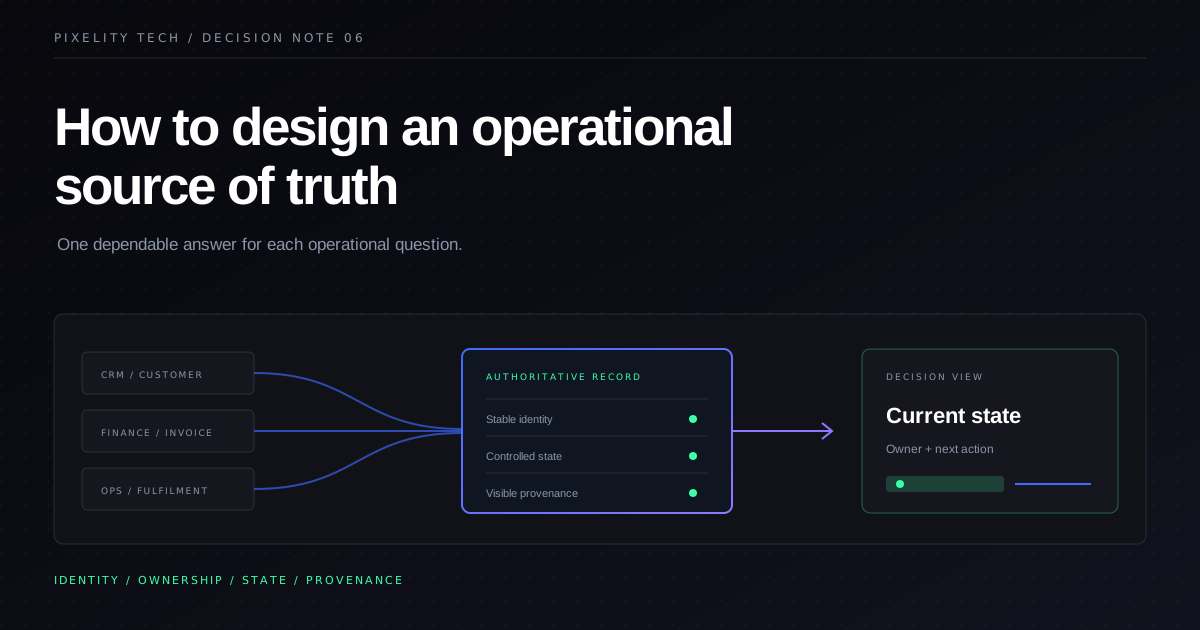
Many companies ask for “one source of truth” when what they actually want is one place to look.
Those are different goals.
A dashboard can display information from several systems without resolving which system owns a value, how fresh it is, or what happens when sources disagree. It creates one view, but not necessarily one truth.
An operational source of truth is a set of explicit ownership and reconciliation rules. It tells the business which record is authoritative for each decision, how state changes, where data came from, and how conflicts are handled. The interface matters, but the operating model underneath it matters more.
Define truth at the level of an entity and field
No single application needs to own everything.
A CRM may own a customer’s sales relationship, an accounting platform may own invoice and payment state, an identity provider may own user authentication, and a custom operations system may own fulfilment status. Each can be authoritative within a defined boundary.
Start by identifying the important business entities:
- customer;
- contact;
- supplier;
- product or service;
- order or engagement;
- job or case;
- approval;
- invoice;
- document;
- location or asset.
Then assign ownership for the fields and state that matter. “Customer data lives in the CRM” is still too broad if finance can update the legal billing name while sales owns relationship notes. Define who can create, change, approve, and correct each important value.
The output can be a simple ownership table. Its purpose is to stop integration logic and user behavior from inventing conflicting answers later.
Give records stable identities
Names are not identifiers. The same company may appear with abbreviations, local spellings, or different legal entities. Email addresses change. Invoice numbers can overlap across suppliers. Spreadsheet row numbers disappear when data moves.
Assign stable identifiers within the authoritative system and maintain mappings when connected systems use different identifiers. Do not rely on repeated fuzzy matching during every synchronization.
Identity decisions need business input. Engineering can find similar records, but only the organization can decide whether two customer entries represent a duplicate, a parent and subsidiary, or distinct legal relationships.
Keep the mapping and merge history. When records are combined or separated, downstream users should be able to understand what changed.
Model state as a controlled lifecycle
Operational truth is not only a collection of fields. It includes where work is in a process.
Define a small set of named states for each important workflow and the allowed transitions between them. For example, a request may move from draft to submitted, under review, approved, scheduled, completed, or cancelled. The precise states should reflect real decisions, not every minor activity.
For each transition, specify:
- who can perform it;
- what information is required;
- which rules must be satisfied;
- what evidence is recorded;
- what downstream actions occur;
- whether and how the change can be reversed.
This turns status from interpretation into behavior. It also provides a useful event history: not just the current value, but how and why the operation reached it.
Pixelity’s business systems service focuses on these operational lifecycles rather than treating the system as a collection of data-entry screens.
Record provenance and freshness
When information is brought together, users need to know where it came from and whether it is current enough for the decision.
For integrated fields, retain useful provenance such as the source system, source identifier, time observed, and synchronization result. The interface does not need to display all of this constantly, but it should be available for investigation and reconciliation.
Freshness requirements depend on the workflow. A management classification may be acceptable when synchronized periodically. Available inventory or an approval state may need faster propagation. Define the requirement from the consequence of stale information rather than defaulting every integration to “real time.”
Real-time architecture adds coordination and failure complexity. Use it when the operation needs it, not because the phrase sounds modern.
Design conflict rules before conflicts happen
Connected systems will disagree. A person edits both sides before synchronization, a delayed event arrives out of order, a required mapping is missing, or one system rejects a value accepted by another.
For each important data flow, decide:
- whether updates move in one direction or both;
- which source wins for each field;
- whether timestamps are trustworthy enough to resolve order;
- which conflicts can be handled automatically;
- which conflicts require human review;
- where unresolved items appear;
- who owns the queue;
- how a correction is replayed downstream.
Do not silently discard conflicts. A reconciliation queue with clear context is often safer than an elaborate automatic rule that hides a wrong decision.
Our systems integration service shows why integration design must include operational ownership, not only data transport.
Separate the operational record from analytical models
An operational system answers “What is true now, and what should happen next?” An analytical model may reorganize the same facts to answer “What pattern has emerged over time?”
These needs often deserve different structures. Operational data favours clear transactions, current state, permissions, and dependable change. Analytical data favours history, aggregation, and comparison across sources.
Do not make teams update a reporting model as if it were the live operation. Equally, do not force every complex analysis into the transactional system. Establish a reliable flow from governed operational records into reporting, with shared definitions for important measures.
Make exceptions first-class work
The happy path rarely damages trust. Unresolved exceptions do.
Design visible queues for records that cannot be matched, synchronized, validated, or completed. Show the reason, relevant source information, attempted actions, owner, and available resolution. Record the resolution so repeated cases can lead to a better rule or upstream correction.
An exception should not disappear into logs that only engineers can access. If it affects an operational decision, it needs a business-facing state and owner.
The AI document operations demo applies the same principle to probabilistic extraction: uncertain results go to human review instead of being written into authoritative records as if confidence were certainty.
Apply permissions and audit at the authoritative boundary
If a system owns an operational fact, it must enforce who can change it. Hiding a button in one interface is insufficient when the same record can be updated through an API, import, integration, or administrative tool.
Enforce authorization at the trusted service boundary. Capture important changes with actor, time, prior value, new value, and reason where appropriate. Protect the audit history from ordinary editing.
The amount of audit detail should match the consequence and sensitivity of the action. The objective is accountable operation and useful investigation, not indiscriminate logging of sensitive data.
Build a view for decisions, not a universal dashboard
Once the ownership model is sound, design interfaces around roles and decisions.
An operations lead may need delayed work, blocked dependencies, and ownership. A finance user may need unreconciled completed work. A service agent may need one customer’s history and next action. An executive may need trends, not the same queue with fewer columns.
Each view can draw from the same governed entities while presenting the context appropriate to the role. “One source of truth” should not become “one screen for everyone.”
Migrate with reconciliation, not hope
Before moving data, profile the sources and document quality issues. Define transformations and business rules. Rehearse the migration using representative records. Validate counts, relationships, required fields, and important totals, but also sample individual records end to end.
Plan the cutover ownership:
- when old sources become read-only;
- which in-flight work moves;
- how changes during transition are captured;
- who approves reconciliation;
- how the organization recovers if validation fails.
Keep source references and migration logs long enough to investigate discrepancies. Data migration is an operational transition, not only a script.
Govern the source after launch
Truth degrades when ownership becomes implicit again. Assign stewards for important entities and definitions. Review data-quality exceptions. Control schema and integration changes. Document new sources and fields. Retire feeds that no longer have a purpose.
When the business changes, update the ownership model and workflow intentionally. A source of truth is not a database installed once. It is an agreement maintained through system behavior and accountable roles.
The design sequence
The practical order is:
- Identify the decisions the operation needs to make.
- Define the entities and state required for those decisions.
- Assign authoritative ownership by field and lifecycle.
- Establish stable identities and cross-system mappings.
- Define integrations, freshness, and conflict behavior.
- Design permissions, audit, and exception ownership.
- Create role-specific operational views.
- Migrate and reconcile representative data.
- Assign governance after launch.
If teams currently assemble truth from several files and tools, begin with the business systems service. The goal is not one giant system. It is one dependable answer for each operational question, with ownership and evidence behind it.
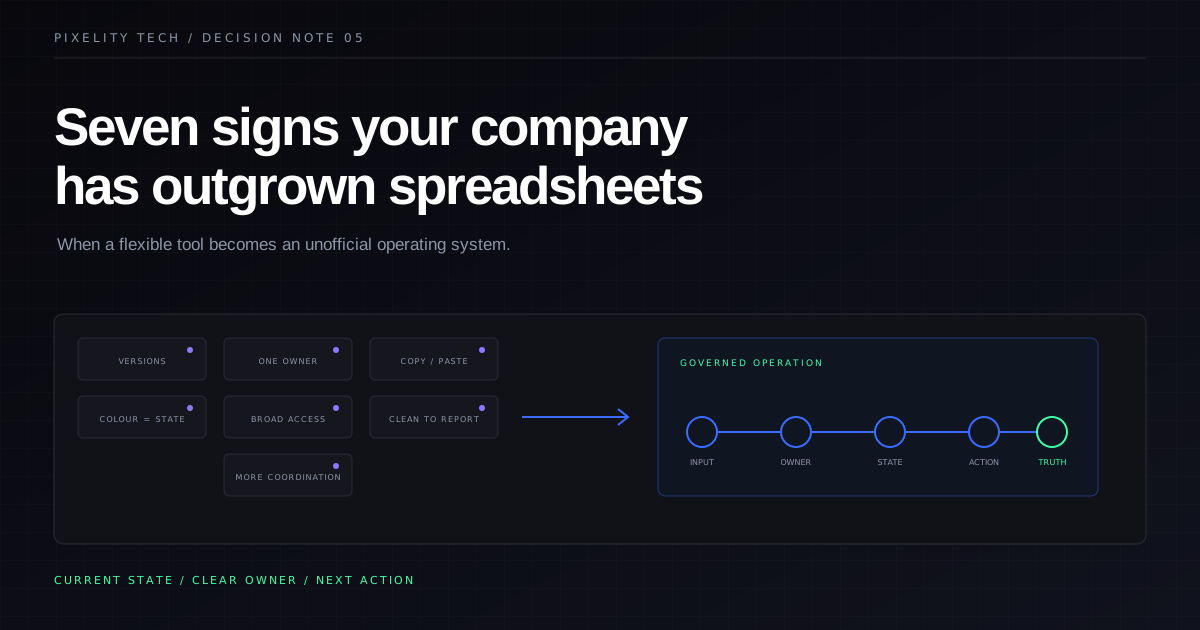
Seven Signs Your Company Has Outgrown Spreadsheets
Spreadsheets are excellent tools until they become an unofficial operating system. These seven signs show when a process needs a governed business system instead.
Read field note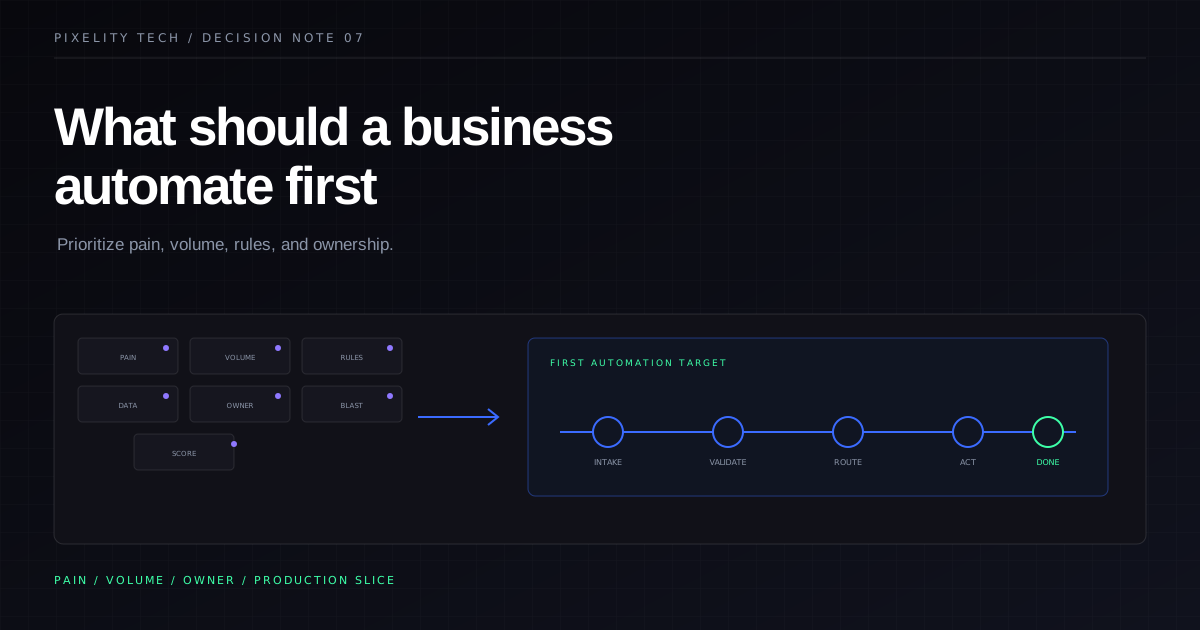
What Should a Business Automate First?
Automation should follow pain, not ambition. Use this prioritization framework to choose the first workflow worth automating without overbuilding.
Read field note