Operations analyst
Works the review queue, corrects extractions, and resolves the validation failures the rules raised.
A model pulling the total off an invoice proves very little. The work is everything after it — the checks, the permissions, the uncertain cases, and proving months later how that figure reached the ledger.
Use the model for interpretation. Keep the rules, the permissions, the corrections, and the accountability explicit and human.
The system takes documents from email, upload, API, or batch import; classifies them and extracts fields with a confidence signal and the region of the source each one came from; validates the result against business rules and the records it has to match; sends anything uncertain, high-value, or policy-sensitive to a named reviewer; and writes the approved outcome to the system of record with the source, the model output, the correction, and the decision kept together.
Invoices, customs paperwork, certificates, and applications are read and re-keyed by people whose judgment is the reason they were hired.
A wrong vendor, amount, or reference passes into finance and surfaces at reconciliation, where correcting it pulls several people away from the work that follows.
Output is either trusted wholesale or redone by hand, because nothing routes the doubtful case to a person with the source document beside it.
Invoices arrive, match against the purchase order, post when everything agrees, and stop at a reviewer with the discrepancy named when it does not—so attention goes only where the rules could not settle it.
We have built document intelligence for an investment consortium: LLM pipelines for parsing, structured extraction, and retrieval-augmented Q&A, with validation gates and human review inside the path rather than beside it.
Pixelity Agent Builder answers from a defined set of documents using hybrid retrieval with reranking, returns grounded citations, falls back deterministically when the sources do not support an answer, and is measured against a golden set—so an answer can be checked rather than believed.
Captured from Pixelity's fictional product demonstrations. Organizations, people, and records shown are synthetic.
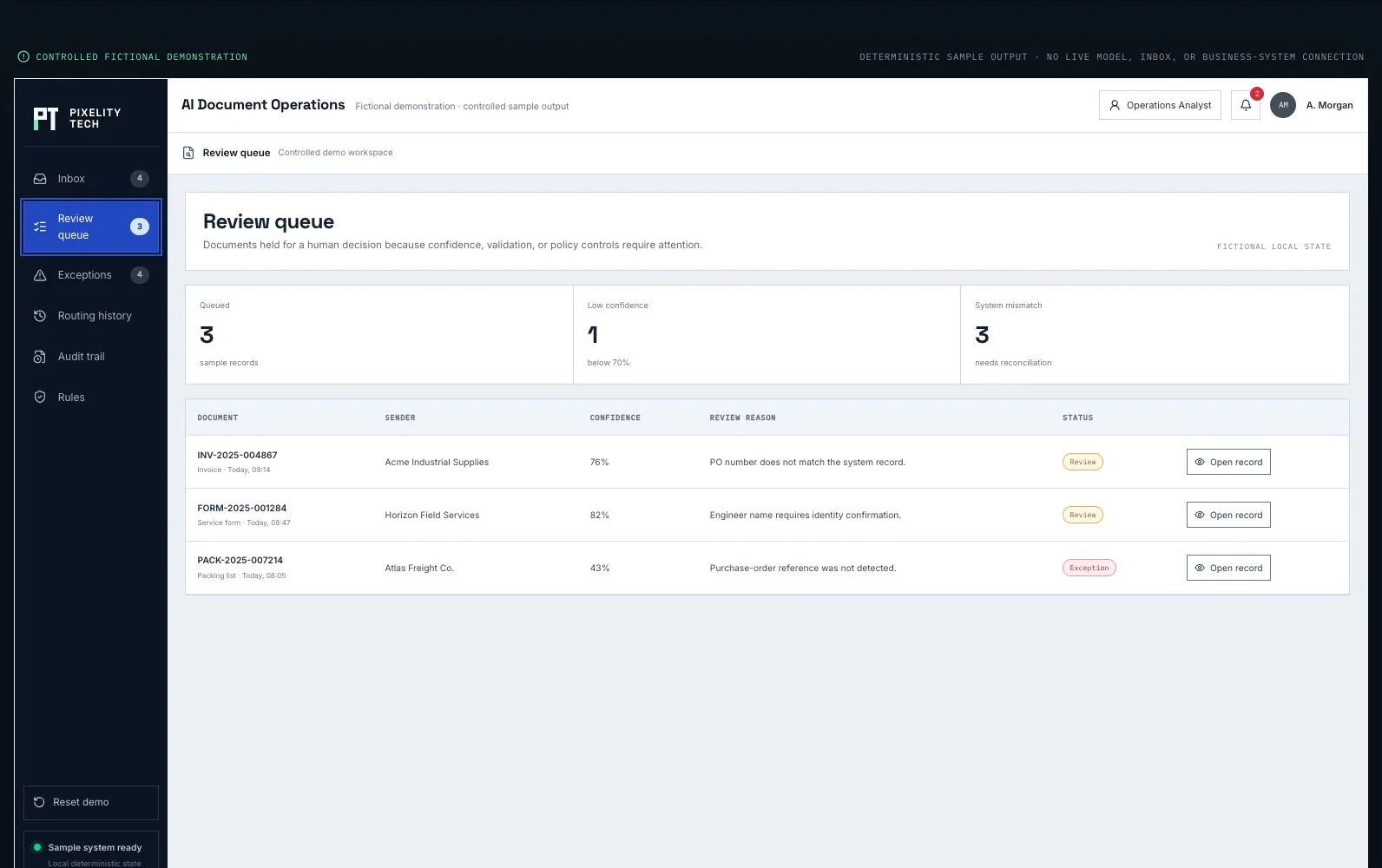
One queue for email, portal upload, API, and batch import, so nothing is processed out of a personal inbox.
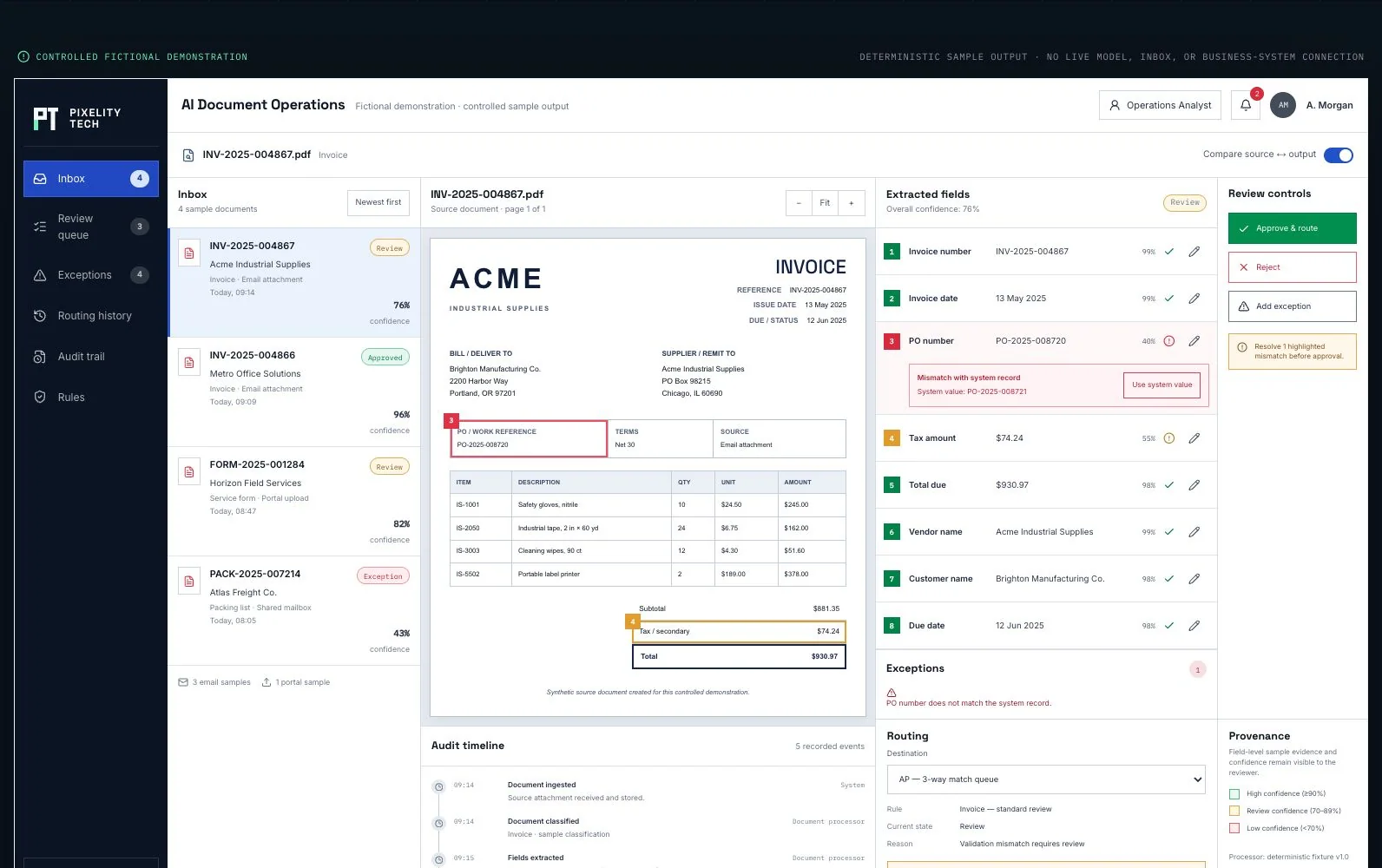
Each field displayed against the part of the source it came from, with a confidence signal and its validation status—so a reviewer checks rather than re-reads.
Business rules and record matching run first; what they cannot settle reaches a reviewer who corrects, approves, or rejects with a reason code attached.
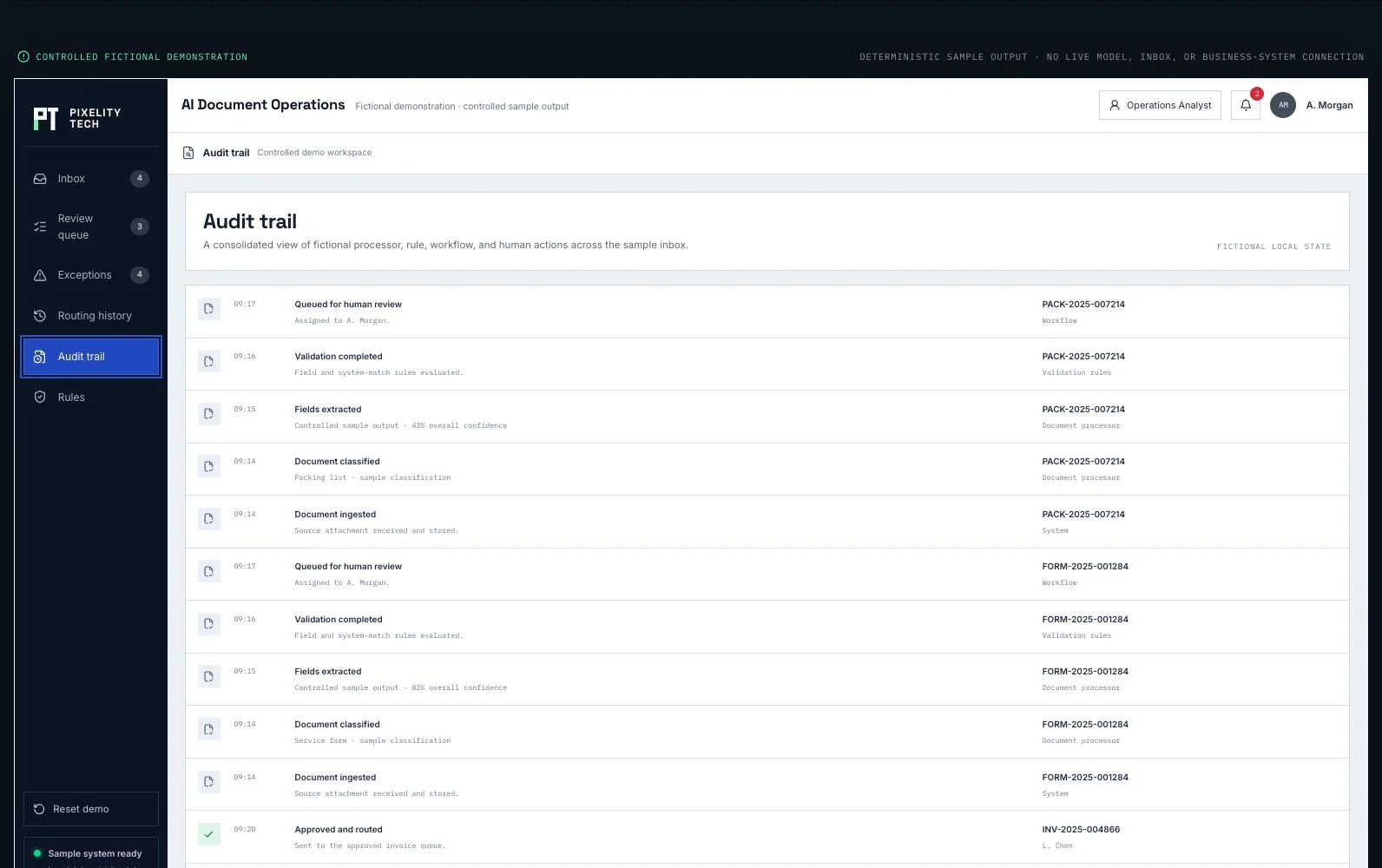
Approved records sync to the ERP or operations system, and the source, the model output, every correction, and the decision stay linked for as long as policy requires.
Works the review queue, corrects extractions, and resolves the validation failures the rules raised.
Approves high-value and policy-sensitive documents before anything posts, with the source in front of them.
Owns the rules, thresholds, routing, and integration health—and reads whether the thresholds are sending too much or too little to people.
ERP or accounts payable for vendor master, purchase-order matching, and posting.
Email and cloud storage for intake and archival, with the archive still the source the audit trail points at.
Model providers chosen per document type for quality, privacy, latency, and cost—and replaceable without rebuilding the workflow.
Notification and exception queues, so a document waiting on a person is visible as work.
Document access by role and by entity or customer boundary, enforced on the server rather than hidden in the interface.
Retention, redaction, and residency rules set by contract and regulation rather than by a provider default.
Human review required by confidence, value, or policy threshold, with those thresholds written down and adjustable.
An audit trail linking source document, model output, every correction, and the routing decision that followed.
A fictional review workspace: extracted fields beside the source document, uncertain output corrected by a person, and the approved record routed on.
Open the demonstrationDocument users, records, decisions, exceptions, integrations, and the smallest release that creates measurable operational value.
Prototype the real screens, permissions, and rules so stakeholders react to a visible system before engineering scope hardens.
Deliver one dependable workflow at a time with testable data, ownership, and reporting—not a long hidden build cycle.
Train users on the live workflow, monitor exceptions and adoption, and extend the platform only when the foundation is stable.
Describe it in a sentence or two. We will come back with what we would build first, what it would take, and whether you actually need us for it.