Set what the model may read, do, and escalate.
A model is worth putting on real work once its limits are written down: what it may read, what it may do, and which cases go to a person. Inside those limits it is a component; outside them, a demonstration.
- 01Receive
- 02Interpret
- 03Validate
- 04Review
- 05Record
Start with one task where a correct answer is already recognizable. Scope widens on measured quality, nothing else.
Nobody can say what the model is allowed to touch
Leadership can see where extraction, classification, or search would pay for itself. Compliance, finance, and operations ask the reasonable questions first: where did this answer come from, what can it change without anyone noticing, and who is accountable when it is wrong. While those have no answer, AI stays in a pilot and the work it was meant to take on stays manual.
How the problem shows up day to day.
- 01
Answers arrive without a source
Output that cites nothing can only be judged on how confident it sounds. Verifying it properly costs about as much as doing the work, so it ends up used for nothing that matters.
- 02
The tool sits outside the permission model
An assistant beside the system reads whatever is pasted into it, has no idea what the person asking is entitled to see, and cannot write a result back to the record the work is tracked on.
- 03
Being wrong has no route
Nothing scores confidence, no rule stops an implausible value, no reviewer owns the uncertain cases, and a correction is a private edit the system never learns about.
How work moves today.
- 01
Reading and re-keying by hand
Documents, emails, and forms are read, interpreted, and typed into operational systems by the people hired for the work that follows.
- 02
Private experiments in consumer tools
Individuals paste business material into whatever chat tool they have, outside the records, the permissions, and the retention rules that govern everything else.
- 03
Adopted wholesale or banned outright
With no evidence either way, the policy becomes trust everything or forbid everything, and both positions are held on instinct.
- 04
Corrections go nowhere
Someone fixes a wrong output in their own copy. Nothing records what was wrong, so quality is never measured and the same error returns.
How the same work moves once the system holds it.
- 01
Bounded intake, inherited permissions
Material enters a system with defined retention and access, and the model answers under the permissions of the person asking, so it cannot surface a record they could not open themselves.
- 02
A grounded proposal with its evidence
The model proposes fields, a classification, or an answer, with the source it used shown beside the original and a confidence attached to it.
- 03
Deterministic checks, then a named reviewer
Rules verify formats, identifiers, totals, and policy before an output counts. Low confidence and high consequence route to a reviewer with the source in view and the tools to correct it, and when the model is unavailable the work falls back to the manual path rather than stopping.
- 04
Recorded, then measured
Approved output writes to the system of record with what was proposed, what was corrected, and by whom. Accuracy, override rate, latency, and cost are tracked, and scope widens only where they hold.
What has to be built for that to hold.
- 01
Task boundary and permission model
The narrow job the model is given, what a wrong answer does downstream, which steps stay deterministic because a rule already decides them, and the permissions every output inherits.
- 02
Validation gates and review workspace
Checks before and after the model, and one place where the source, the extracted fields, the correction, and the approval sit together. We have built this shape for an investment consortium: parsing, structured extraction, and retrieval-augmented answers, with validation gates and human review at the points where being wrong would matter.
- 03
Evaluation, monitoring, and fallback
A fixed set of representative cases the system is scored against before and after each change, quality and cost watched in production, and a defined answer for when the model is out of its depth. Pixelity Agent Builder answers only from approved material, cites its sources, is scored against a golden set, and returns a deterministic fallback rather than a guess.
Screens from a related demonstration.
Captured from Pixelity's fictional product demonstrations. Organizations, people, and records shown are synthetic.
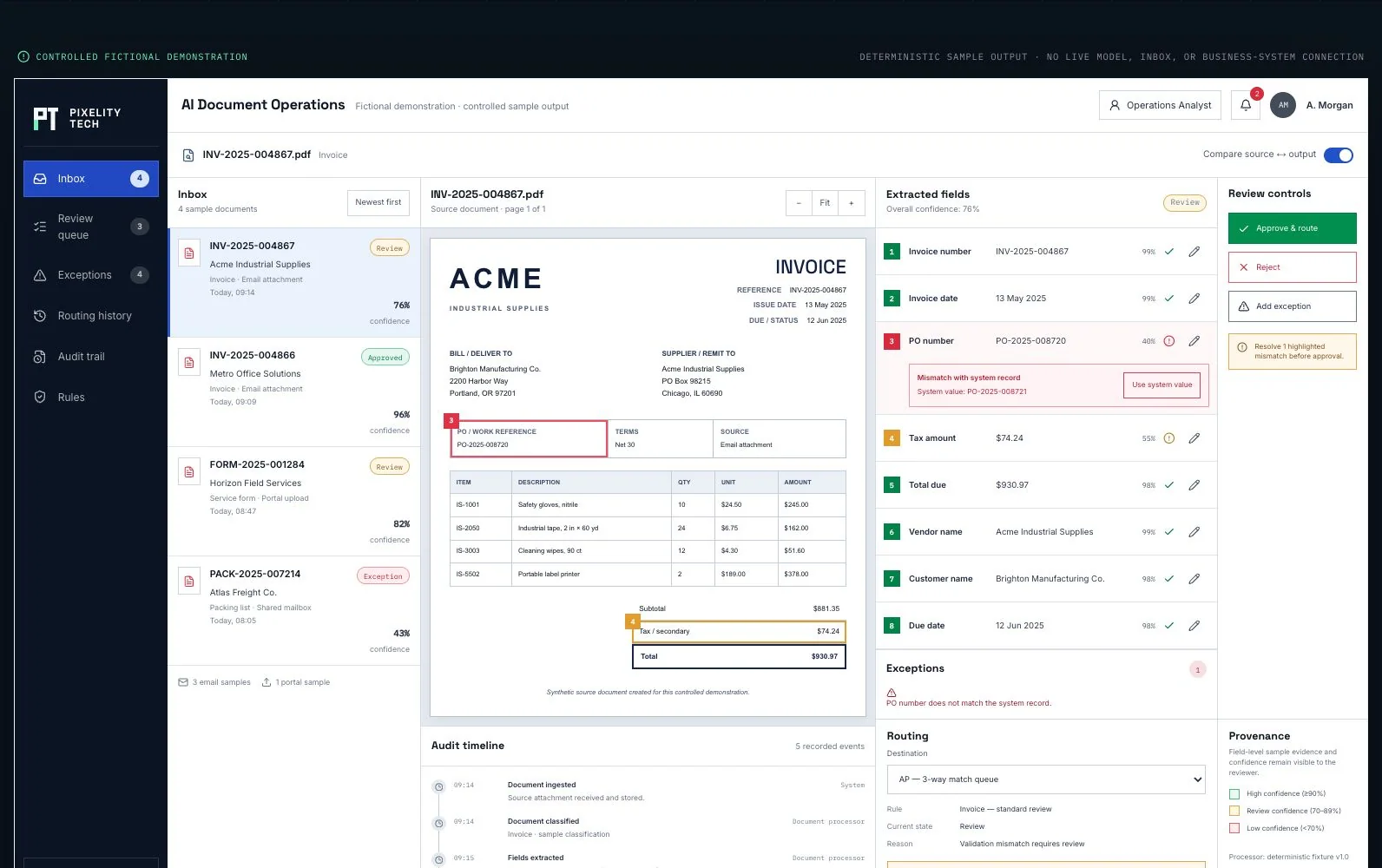
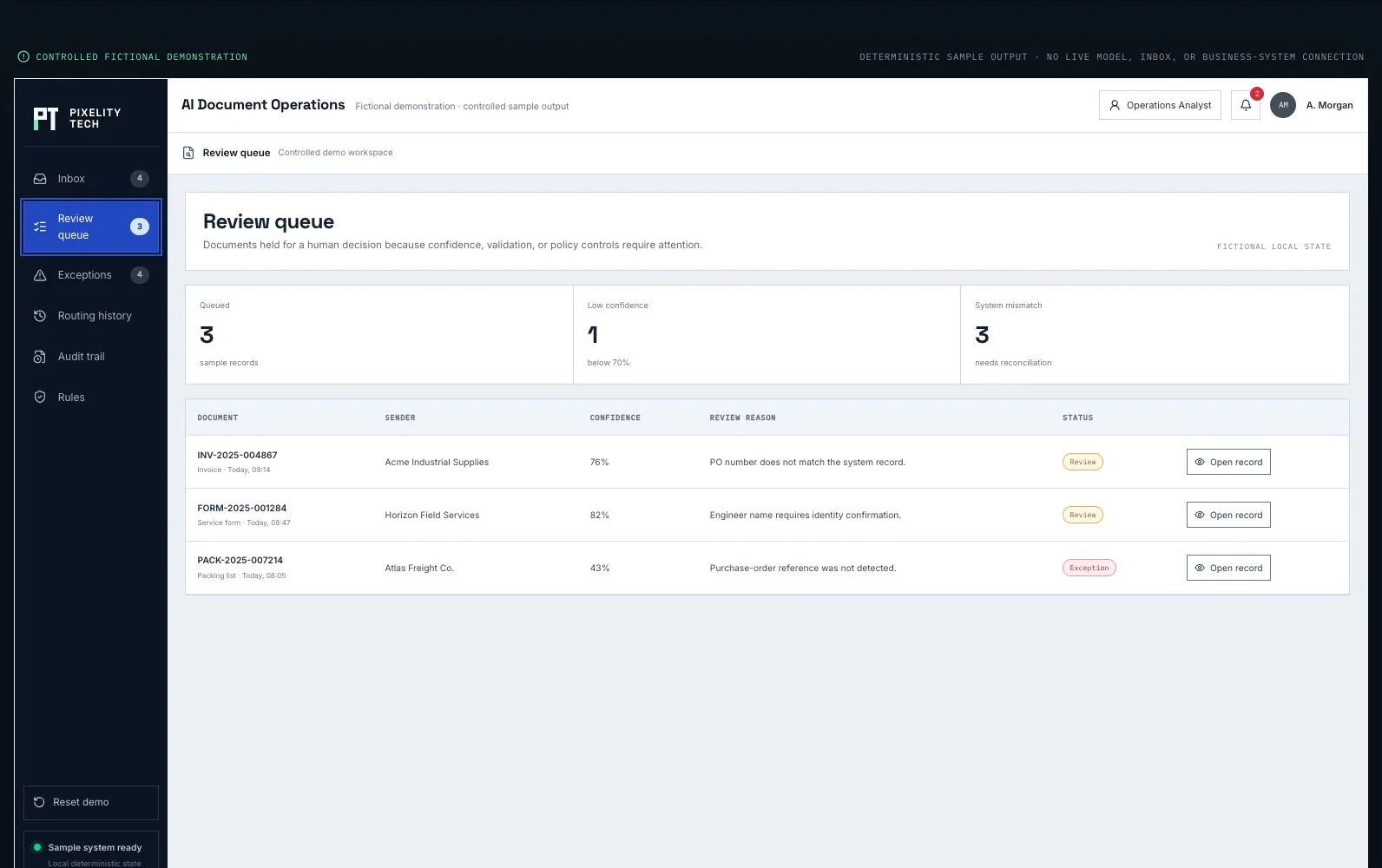
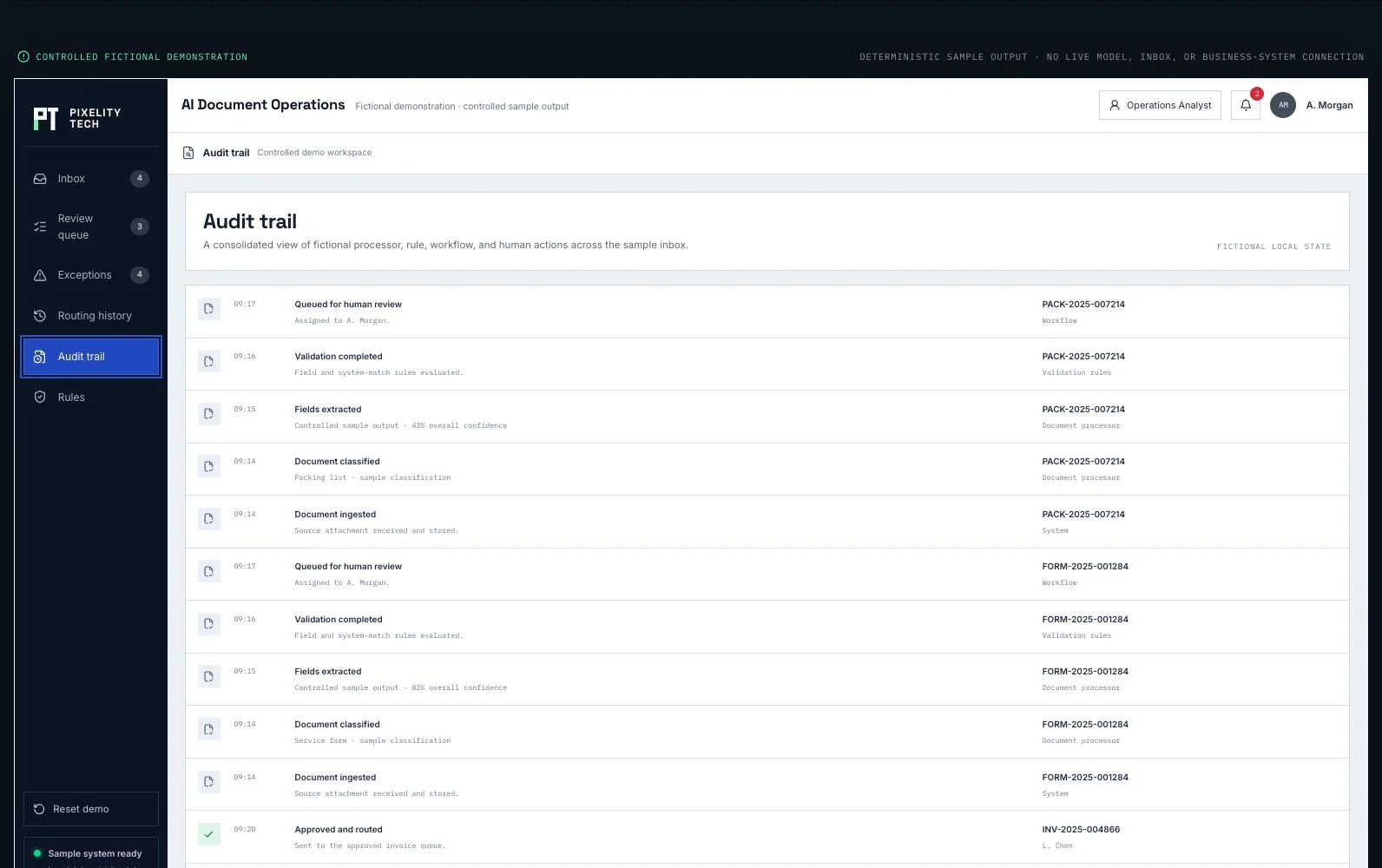
AI Document Operations
A fictional document workflow where each extracted field carries its source, uncertain cases wait for a reviewer, and the audit trail keeps what the model proposed beside what a person approved.
Open the demonstration- 01Inbox
- 02Extraction
- 03Validation
- 04Human review
- 05Audit
The kinds of system this usually becomes.
Adjacent problems that often appear together.
Articles that help frame the decision.
Tell us the process everyone works around.
Describe it in a sentence or two. We will come back with what we would build first, what it would take, and whether you actually need us for it.