Pixelity Tech / Field note
How Human Review Makes AI Systems Safer
Human review is not a fallback for weak AI. It is an operational control—thresholds, queues, authority, and audit—that makes probabilistic automation acceptable in production.
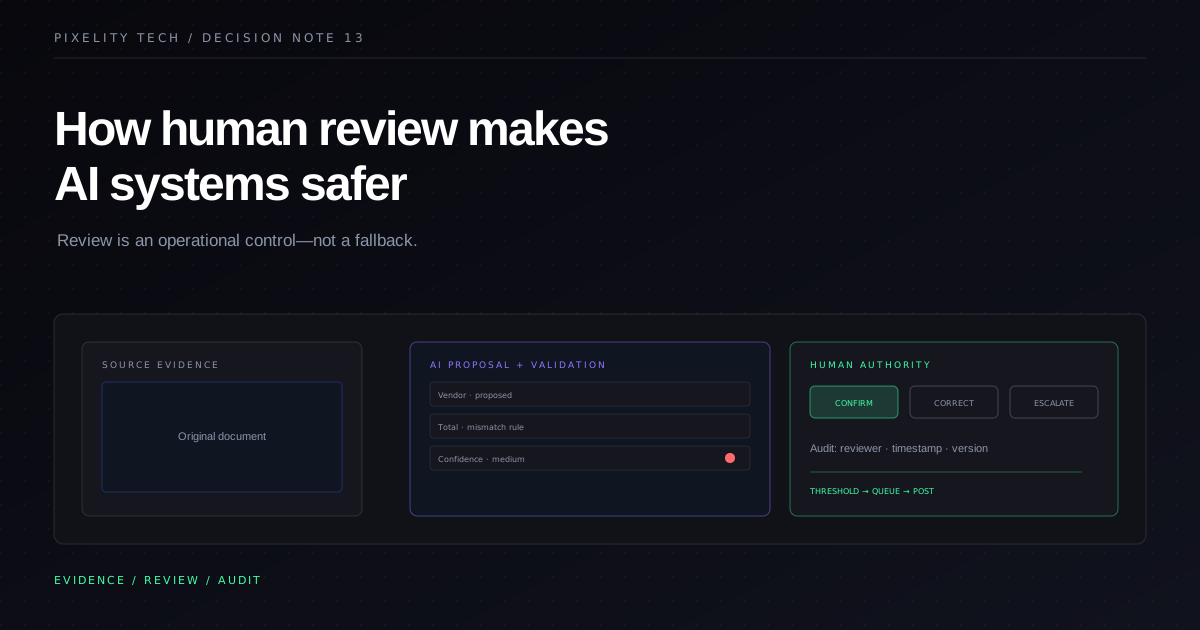
“Human in the loop” has become a reassuring phrase in AI product marketing. It suggests responsibility without describing mechanics. In operations, mechanics are what matter: which cases require review, what reviewers see, how long they have, what they can override, and how corrections change future behavior.
Human review is not a temporary bridge until models become perfect. It is a durable control — like approval thresholds or segregation of duties — that makes probabilistic automation acceptable where errors would hurt customers, finances, or compliance.
Treating review as first-class workflow design, not as an error message, is the difference between AI pilots and AI systems people trust.
Why probabilistic automation needs human controls
Rules-based automation is deterministic. Given the same inputs, it produces the same outputs. AI automation is probabilistic. Inputs vary in quality; models drift; edge cases look plausible.
That does not make AI unsuitable for business work. Much operational intake is already probabilistic because humans misread, mistype, and overlook details under time pressure. The question is whether the organization detects and contains errors before they propagate.
Human review contains error at defined boundaries. It converts “the model said so” into “a named person authorized this outcome under visible evidence.”
Without those boundaries, teams either over-trust automation or revert to manual processing entirely. Neither outcome compounds.
Review is a control, not a confession of failure
Some teams hide review queues as embarrassment — evidence that the model is not “good enough yet.” That framing encourages removing review as soon as marketing allows, even when risk still warrants it.
Mature operations treat review as governance:
- segregation of duties — the system that proposes should not be the sole authority that commits;
- sampling — even high-confidence paths may be spot-checked;
- escalation — ambiguous cases rise to roles with appropriate authority;
- auditability — reviewers, timestamps, and evidence are recorded;
- continuous improvement — corrections feed monitoring and rule updates.
Approval systems have enforced similar principles for years. AI does not remove the need. It shifts where preparation happens.
Design review around decisions, not around models
Start from decisions that must not be wrong, then work backward to review placement. Examples:
- releasing payment above a threshold;
- accepting a contract clause that affects liability;
- onboarding a vendor with compliance implications;
- posting inventory adjustments that affect fulfillment promises;
- responding to regulated customer complaints.
For each decision, define:
- what evidence is required;
- who may authorize;
- what validations must pass automatically;
- what happens on rejection or timeout;
- how outcomes are written to systems of record.
AI may prepare any of the evidence. Review ensures the decision point remains accountable. Where AI belongs in a business workflow maps these stages before controls are wired.
The four components of effective review queues
A review queue is not an inbox with a model badge. Effective queues include four components.
1. Source evidence in context
Reviewers must see the original document, message, or attachment beside proposed fields. Scrolling between systems invites oversight. Side-by-side evidence is non-negotiable for document workflows.
The AI document operations demo uses this layout deliberately: source, extracted fields, validation results, and actions in one record.
2. Machine-readable validation results
Reviewers should not hunt for why an item queued. Display failed rules plainly: missing purchase order, total mismatch, unknown vendor, date out of period.
Validation is where rules-based automation protects AI. Models propose; rules enforce policy.
3. Authority-appropriate actions
Actions must match role: confirm, correct fields, reject, escalate, request more information, route to specialist teams. Avoid generic “approve” buttons that do not say what is being approved.
Overrides should require intent, not accidental clicks. High-impact corrections may need secondary confirmation or peer review.
4. History that survives disputes
Record model version, rule version, confidence signals, reviewer identity, before/after values, and downstream postings. When a customer or auditor asks what happened, the answer should be reconstructable without reconstructing logs from three tools.
Thresholds: connect confidence to action
Confidence scores without thresholds are decoration. Operational thresholds tie signals to behavior:
| Band | Typical production behavior |
|---|---|
| High confidence + clean validation | Auto-route with sampling audit |
| High confidence + validation warnings | Mandatory review |
| Medium confidence | Review queue with suggested fields |
| Low confidence | Manual processing template |
Thresholds are business decisions, not data science trivia. Finance may accept different risk than customer support. Document categories may use different bands. Owners should adjust thresholds based on measured error cost, not demo optimism.
Sampling auto-processed items remains essential. High confidence does not mean zero error. Sampling detects drift before it becomes a quarter-end surprise.
SLAs and queue discipline
Review queues fail when volume outpaces capacity silently. Define:
- maximum age before escalation;
- ownership when reviewers are unavailable;
- prioritization rules for risk, value, or customer impact;
- metrics surfaced to leadership — not hidden in a team backlog.
An aging exception queue is an operational incident, not a personal productivity issue. The operations command center demo treats exceptions and approvals as visible workload for this reason.
Feedback loops that improve the system
Human review generates valuable signal when captured deliberately:
- which fields are corrected most often;
- which validation rules fire repeatedly;
- which document layouts confuse extraction;
- which categories should split or merge;
- which auto-routed items fail sampling.
Feed this signal into rule updates, template changes, training data refinement, and vendor conversations — with change control. Corrections should not live only in reviewers’ heads.
Avoid uncontrolled “the model learned overnight” stories. Version prompts, models, and rules together. Communicate policy changes to users.
Roles and training reviewers actually need
Reviewers need more than tool access. They need:
- clarity on what they are certifying;
- authority to reject without workaround paths;
- access to reference data — vendor lists, contract clauses, prior cases;
- escalation paths for novel situations;
- protection from pressure to clear queues at the expense of accuracy.
Training should explain what AI does in this workflow, what it does not do, and how to document overrides. Reviewers are not model babysitters. They are control owners for their slice of risk.
When to require human review by policy
Some categories should always review regardless of confidence:
- new vendors or bank detail changes;
- first-time document formats until baselines exist;
- legal or regulatory triggers;
- customer-specific contractual exceptions;
- material financial adjustments.
Policy-based review coexists with confidence-based review. Both should be explicit in workflow design.
Integrating review outcomes without duplicate entry
A common failure mode: reviewers correct fields in a queue, then someone re-enters the same data into ERP or CRM. Review must write outcomes to governed integrations once, with the same identifiers used upstream.
This is where automation versus integration returns. Review is not an island. It is a control point before systems of record change.
Measuring safety, not just speed
Track metrics leadership should recognize:
- auto-process rate versus exception rate;
- correction rate by field and category;
- time in review queue;
- downstream error recurrence after posting;
- sampling failure rate on auto-processed items;
- repeat exceptions from the same source.
Speed matters. Safer systems also reduce rework, disputes, and manual reconciliation. Present both when scaling volume.
Human review and organizational trust
Trust compounds when users see that exceptions are handled honestly: no hidden auto-approvals, no unexplainable routing, no dead-end queues. Trust erodes when review is theater — a screen to click through while outcomes were already committed elsewhere.
Introduce AI safely is therefore a workflow program: placement, thresholds, review, integration, audit, monitoring. Not a model purchase.
Review makes AI eligible for production
AI without review may work in experiments. AI with review can work in operations — where names, money, and commitments are attached to outcomes.
Pixelity’s AI-enabled software service designs review queues, validation, and audit trails as part of the product, not as a disclaimer footnote.
If your team is scaling document or inbox automation, map your workflow with Pixelity Tech and define the human controls that make probabilistic steps production-safe.
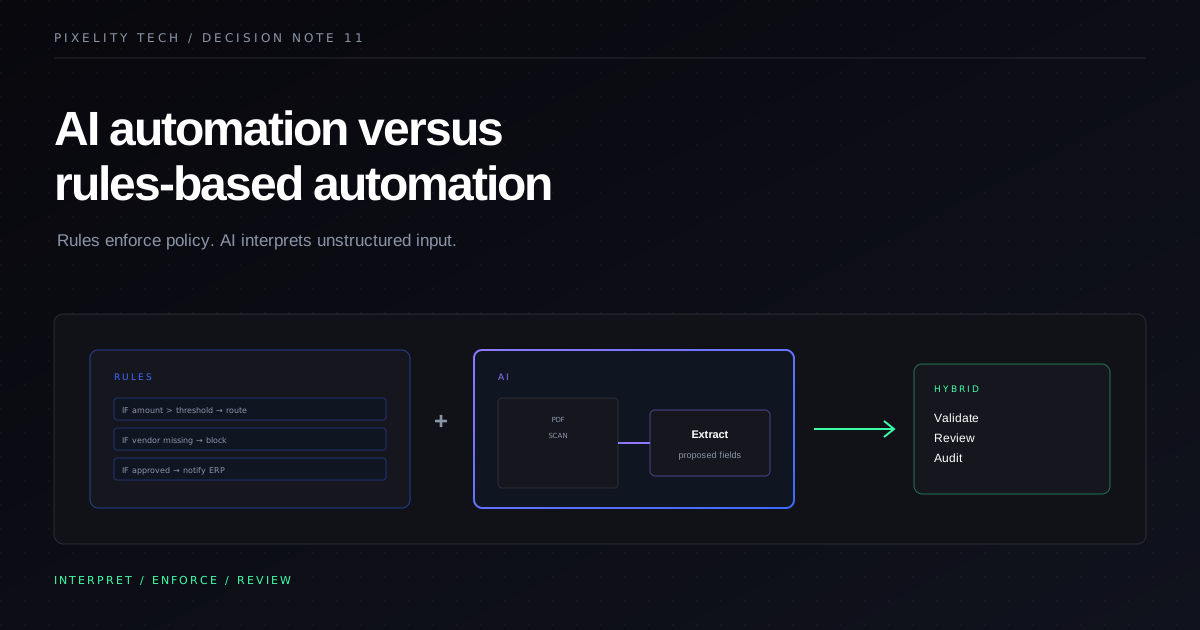
AI Automation Versus Rules-Based Automation
Rules execute policy. AI interprets unstructured input. Learn when each approach fits, how to combine them, and why human review belongs in the architecture.
Read field note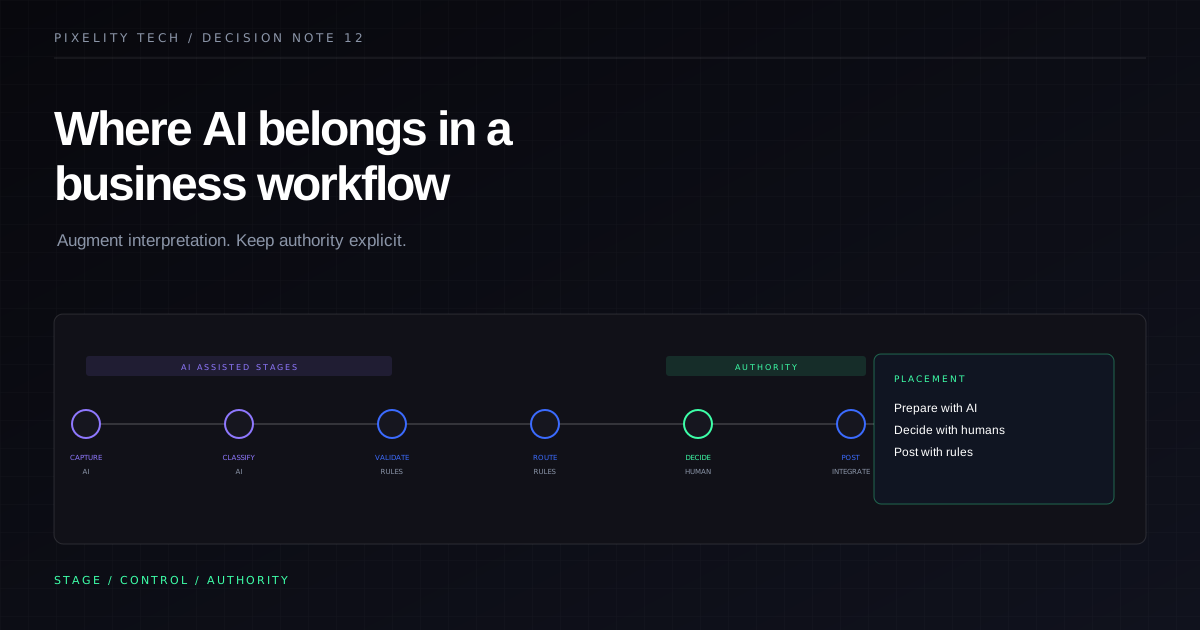
Where AI Belongs in a Business Workflow
AI creates the most value at specific workflow stages—not everywhere. Use this placement model to augment intake, classification, and preparation while keeping authority explicit.
Read field note