Pixelity Tech / Field note
Where AI Belongs in a Business Workflow
AI creates the most value at specific workflow stages—not everywhere. Use this placement model to augment intake, classification, and preparation while keeping authority explicit.
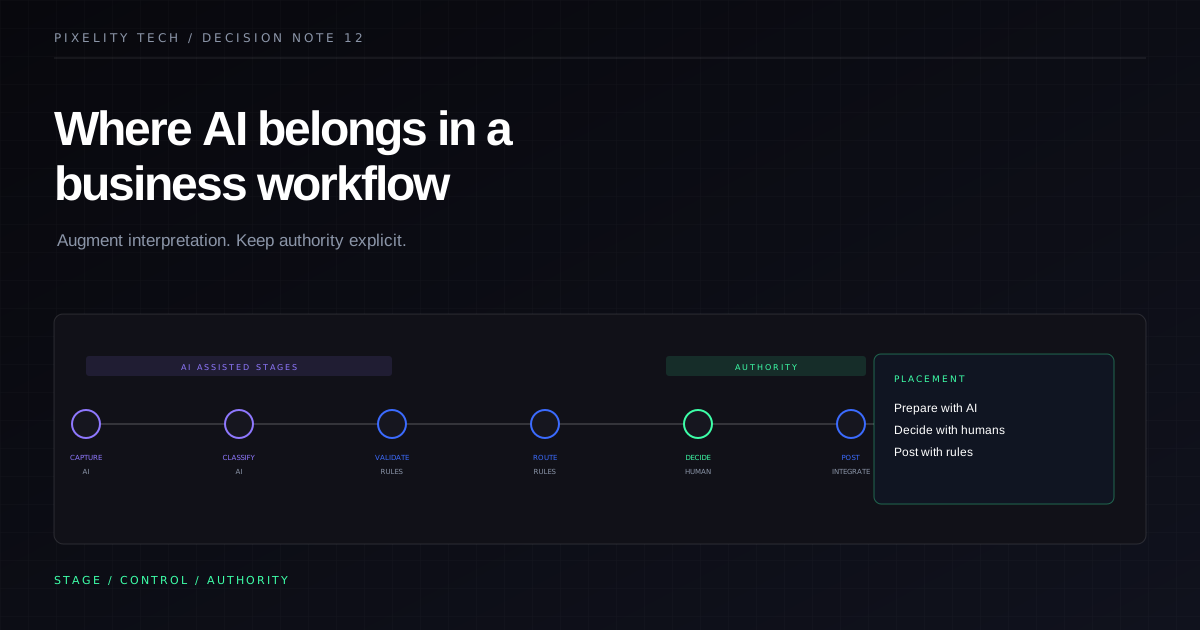
Artificial intelligence is often introduced as a layer on top of everything: search across the company, assistants in every screen, models that draft, classify, and decide. The result can be impressive in demos and disappointing in operations.
The gap is placement. AI creates disproportionate value at specific stages of a workflow — usually where unstructured input enters, where large volumes must be triaged, or where humans currently read and re-type information. It creates risk when placed at stages that require accountability, legal authority, or deterministic policy enforcement without guardrails.
Thinking in workflow stages clarifies where AI belongs, where rules belong, and where humans must remain the system of record for decisions.
Start with the workflow, not the model
A business workflow is a repeatable path from trigger to outcome: intake, validation, routing, decisions, integrations, notifications, closure, and exceptions. Each stage has different requirements for evidence, speed, and accountability.
Before selecting models, document one real process as it runs today:
- what triggers work;
- what format information arrives in;
- which systems must receive outcomes;
- who can authorize transitions;
- what exceptions recur;
- what audit trail regulators or customers expect.
If this map is incomplete, AI will automate guesswork. The guides on what should a business automate first and when not to automate a process apply directly: clarity precedes execution.
The placement model: six stages
Use six stages to decide whether AI is appropriate.
1. Capture and intake
What happens: Requests, documents, messages, or files arrive and become operational records.
AI fit: Strong when intake is unstructured — PDF invoices, scanned forms, email threads, attachments with variable layouts. Models can extract candidate fields, detect document type, and attach source evidence.
Cautions: Intake is not approval. Extracted values are proposals until validated.
Better together: Structured forms for known categories; AI for the long tail of variable documents.
2. Classification and enrichment
What happens: Work is categorized, linked to entities, and enriched with reference data.
AI fit: Strong when categories are expressed in language rather than codes — “urgent facilities leak” versus a typed category list. Also useful for matching free-text line items to catalog entries with human confirmation.
Cautions: Taxonomy drift. If categories change monthly without governance, model labels will lag policy.
Better together: Rules for stable categories; AI suggestions with confidence thresholds for ambiguous text.
3. Validation and policy checks
What happens: The system enforces required fields, thresholds, duplicates, and compliance constraints.
AI fit: Limited. Validation should be deterministic where possible.
Cautions: Letting a model “validate” payment totals or regulatory eligibility without hard rules invites plausible errors.
Better together: AI proposes values; rules-based automation enforces policy.
4. Routing and assignment
What happens: Work is directed to roles, teams, or queues based on category, risk, capacity, or geography.
AI fit: Moderate for prioritization signals — urgency detection, sentiment, anomaly flags — when treated as input to rules, not as sole authority.
Cautions: Routing must be explainable. “The model sent it to you” is not an operational answer.
Better together: Rules encode authority; AI highlights cases that may need earlier attention.
5. Decision and approval
What happens: Humans or policy authorize spend, exceptions, refunds, contracts, or release to downstream systems.
AI fit: Narrow. Summarization and evidence packaging can help approvers. Auto-approval belongs only behind explicit thresholds with measured risk acceptance.
Cautions: This is where accountability lives. Approval systems exist to record who decided, not which model guessed.
Better together: AI prepares the packet; humans or explicit rules approve.
6. Posting and closure
What happens: Outcomes are written to systems of record, customers are notified, and records are closed with history.
AI fit: Low for financial or contractual posting. Higher for generating customer-facing summaries from approved facts.
Cautions: Integrations must respect field ownership. See automation versus integration.
Better together: Post structured outcomes through governed integrations after validation and approval.
High-value AI placements in operations
Three patterns recur across industries.
Document operations. Invoices, statements of work, delivery notes, and certificates arrive as files. AI reads and proposes structured fields; humans review exceptions; rules validate; finance receives governed postings. The AI document operations demo shows inbox review, queues, routing history, and consolidated audit trails — placement done visibly.
Operations inbox triage. Messages contain mixed intents: status requests, complaints, change orders. AI can classify and link to existing records, reducing time spent sorting. Humans handle nuanced responses.
Knowledge-assisted preparation. Models summarize long threads, compare attachments, or highlight missing evidence before an approver opens a record. This reduces reading time without removing authority.
In each pattern, AI shortens preparation. It does not replace the control points that protect the business.
Low-value or high-risk AI placements
Be skeptical when vendors propose AI at:
- final approval without thresholds and audit sampling;
- bi-directional sync between systems that already disagree;
- policy authoring that nobody validates against real exceptions;
- customer commitments that bind pricing, liability, or delivery without human review;
- reporting as truth when upstream definitions remain broken.
These placements optimize demos, not operations. They also erode trust when the first serious exception exposes gaps.
Designing handoffs between AI, rules, and people
Every AI placement needs explicit handoff rules:
| Signal | Typical action |
|---|---|
| High confidence + passes validation | Auto-route to next stage |
| High confidence + fails validation | Exception queue with reason |
| Medium confidence | Review queue with evidence highlighted |
| Low confidence | Manual processing path |
| Policy conflict | Escalation to named role |
Handoffs should be operational, not cosmetic. A review queue must show source document, proposed fields, validation errors, and similar past cases. A reviewer’s corrections should feed monitoring and improvement loops.
How human review makes AI systems safer expands the control patterns that make these handoffs trustworthy.
Evidence and auditability are part of placement
AI outputs are persuasive even when wrong. Placement therefore includes what evidence users see:
- original source beside extracted values;
- confidence or quality signals tied to actions;
- validation results in plain language;
- history of model version and rule version at time of processing;
- human overrides recorded with identity and timestamp.
Auditors and customers ask what happened, not which model was trendy. AI document processing systems treat audit trails as first-class workflow state, not as logging afterthoughts.
Organizational readiness for AI placement
Technology alone does not make placement succeed. Readiness includes:
- a process owner who can define exception policy;
- agreement on which decisions remain human regardless of automation;
- baseline metrics before launch;
- training that explains what AI does and does not do in the workflow;
- incident response when accuracy drops or provider outages occur.
The introduce AI safely use case sequences these controls before scaling volume.
Sequencing AI within a roadmap
A practical rollout:
- Choose one intake-heavy workflow with measurable manual reading cost.
- Place AI at capture and classification only.
- Add deterministic validations and approval gates.
- Integrate postings to the system of record.
- Measure exception rate, cycle time, and error recurrence.
- Expand categories or adjacent workflows that share entities.
Avoid parallel AI experiments across departments before the first placement is stable. Credibility compounds through one dependable path, not through breadth of pilots.
AI is a stage tool, not a strategy
Strategy is operational improvement: fewer touches, clearer ownership, faster decisions, safer records. AI is one mechanism at stages where interpretation is expensive and unstructured input is real.
Used with deliberate placement, AI removes low-value reading and typing. Used without placement, it adds opacity to processes that were already unclear.
Pixelity’s AI-enabled software service maps workflows first, then places models where they earn their cost — with rules, review, and integrations that respect systems of record.
To decide where AI belongs in your operation, map your workflow with Pixelity Tech and identify the stages where interpretation — not authority — should be augmented.
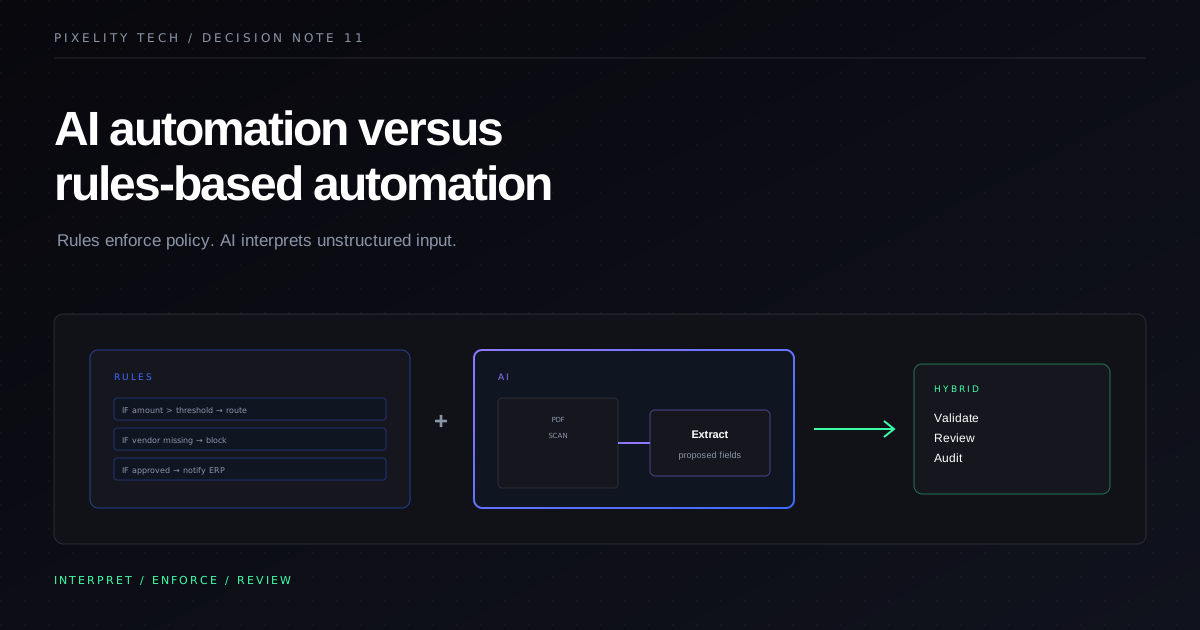
AI Automation Versus Rules-Based Automation
Rules execute policy. AI interprets unstructured input. Learn when each approach fits, how to combine them, and why human review belongs in the architecture.
Read field note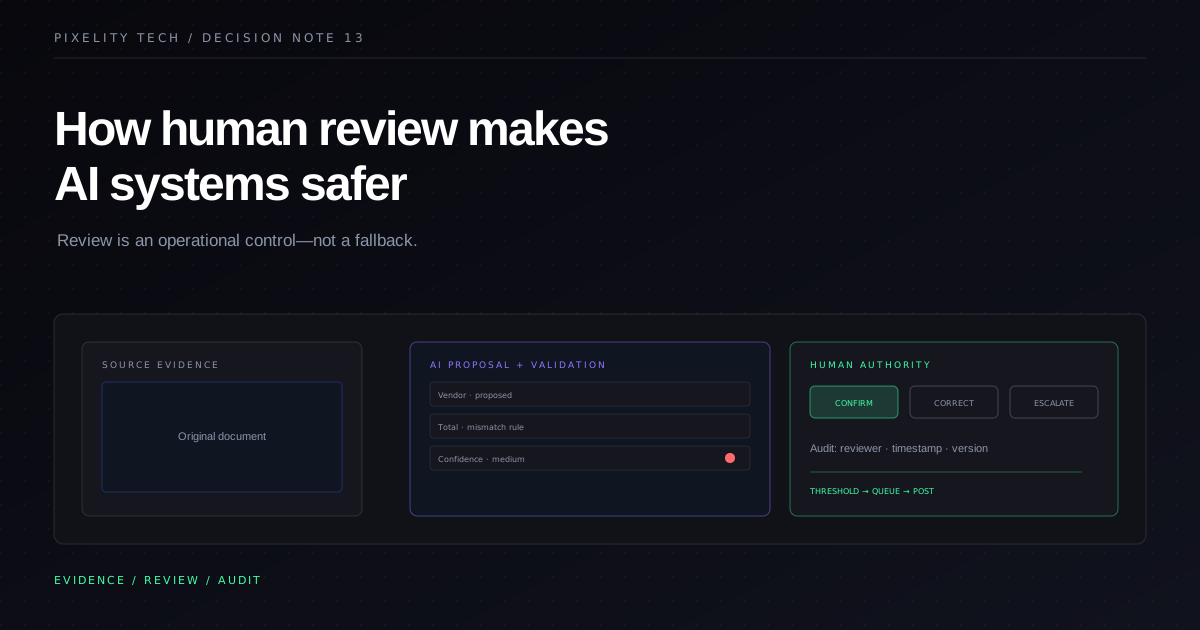
How Human Review Makes AI Systems Safer
Human review is not a fallback for weak AI. It is an operational control—thresholds, queues, authority, and audit—that makes probabilistic automation acceptable in production.
Read field note